Referendum halts Yountville Commons plan; residents overflow Town Council meeting
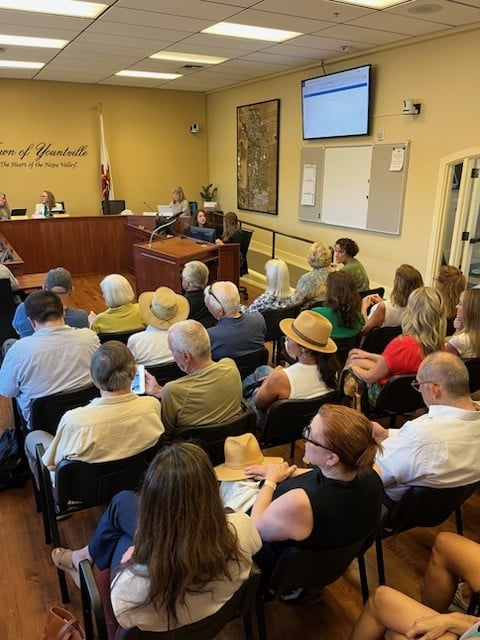
The March 17 Yountville Town Council meeting drew a crowd beyond capacity. Attendees filled the Town Council Chambers, spilled into the Town Hall lobby and overflowed into the Locals Lounge next door where the meeting was live-streamed. Council Member Hillery Trippe was absent due to an unexpected injury.
The first order of business was a report from the town clerk confirming that the referendum circulated in Yountville during the first week of March had been certified by the Napa County Registrar of Voters. Having met the required number of signatures, the ordinance adopted in January to rezone the Yountville Commons property, amend the general plan and revise the municipal code, is now suspended.
Mayor Margie Mohler then motioned to remove the two agenda items related to the Commons project, which were options for a survey by BAE Urban Economics and extending their contract. The motion passed unanimously 4–0.
With that dramatic start, the meeting moved into public comment, where all speakers addressed the Yountville Commons project. More than 10 residents came forward.
Rich Tooker, a 26-year Yountville resident and retired land use planner with extensive housing element experience, expressed concern that the town’s current approach carries significant financial risk. He suggested pursuing an alternative strategy that could achieve the town’s goals while reducing exposure, such as selling some parcels rather than having the town assume the full cost and financial risk.
Carrie Hays asked, “Where do we go from here?” She argued that the best possible outcome must come from a fundamentally different process. She described the current approach as tightly controlled by the town manager and project designers, noting that the volume of public comment in recent meetings reflects growing frustration, rising costs and declining trust. Hays urged the town to form an ad hoc committee of community members to serve as a resource in shaping the plan, rather than simply reacting to it. She emphasized that the community’s vast and varied knowledge is one of the town’s greatest assets.
Eric Appel, a newer resident, reminded the council of its responsibility to act in the town’s best interest and to manage public funds responsibly. He criticized the project for lacking a realistic budget from the outset, noting that millions have already been spent designing a plan that is reportedly $70 million over budget. He referenced the Feb. 17 meeting, where Town Manager Brad Raulston stated that returning to the drawing board was an option and urged the council to take that path.
One of the most impactful speakers was Gary Jabara, owner of The Estate Yountville and the town’s largest employer. Drawing on his experience in commercial real estate, Jabara called it “fiscally and structurally abhorrent” to advance a project to this level without a guiding financial statement. Based on his assessment, he warned the project could push the town’s credit rating into junk status within a few years.
“This is financial mismanagement,” he said. “The people who will be left holding the bag are the residents of Yountville. How can you do such a disservice to this town?” Jabara also questioned why key stakeholders, including employees of The Estate and the Veterans Home, had not been included in the process. He urged the council to “take a deep breath,” refocus on the people the project is meant to serve, and develop a viable financial model. “It’s not rocket science,” he concluded.
Karen Thurling, a Yountville resident and property manager of 44 years, suggested that the strong support for the referendum signals a need to pause and reassess. She advocated for conducting a survey first and ensuring that groups such as Veterans Home staff and vineyard workers are included. “Don’t build a phase and then use it to learn what to fix later,” she said. “This should not be a ‘learn as we go’ process.”
Daniel Worku of Sotheby’s Yountville office emphasized the importance of preserving the town’s character. “This town is a treasure; treat it as such,” he said, urging the council to move more slowly and allow for greater dialogue, given the scale and permanence of the project.
Jocelyn Lin of Burbank Housing spoke about the organization’s success in developing and managing more than 5,000 affordable housing units. While expressing support for the Commons project and its potential benefits for the workforce, she noted that the voices of those workers have been absent from the discussions.
A representative from Napa Solano for Everyone, a regional affordable housing advocacy group, also voiced support for the project. He acknowledged that improvements could be made but emphasized that many people in the region support apartment and studio housing and are encouraged by the proposal.
In general, the council does not respond to comments made during the public comment period, leaving no immediate indication of how these concerns were received.
The next Town Council meeting on April 7 will include discussion of the referendum and how the town intends to move forward.