Napa County Master Gardeners: Monarchs rule!
Monarchs rule! Not in the same way as King William of Orange, after whom these butterflies were named, but their regal appearance, striking color and many mysteries continue to capture people’s imagination since the first European settlers labeled them in the early 1600.
More recently, monarchs have become a poster child for disappearing natural beauty. The U.S. Fish and Wildlife Service has proposed listing them as threatened under the Endangered Species Act. Unfortunately, they did not qualify for endangered status even though they are projected to disappear in the next 20 years.
Let’s take a closer look at these amazing creatures, some factors contributing to their decline and various conservation programs that could help turn the tide.
But first, a few special things about monarchs on the eastern side of the Rocky Mountains.
Each year millions of monarchs fly about 3,000 miles from Canada to their overwintering sites in central Mexico, a remarkable feat considering that they are not great flyers. They don’t vigorously flap their wings but rely on thermals to gain altitude and glide. Even at that, they manage to travel up to 100 miles a day.
Sometimes unpredictable wind currents deposit monarchs in Florida rather than in Mexico, but their extraordinary navigational capabilities eventually lead them to their destination. How do they manage without Google Maps?
As it turns out, monarchs have their own compass. It is a combination of the sun’s position, determined via an internal circadian clock built into their antennae, and the ability to sense the Earth’s magnetic field.
To undertake this two-month migration, monarchs breed a special Super Generation. Unlike previous generations that live only a few weeks, the Super Generation is stronger, larger in size and can live up to eight months due to a suppressed juvenile hormone that prevents monarchs from aging, as well as reproducing. (Imagine if humans could control their hormones at will instead of relying on drugs.)
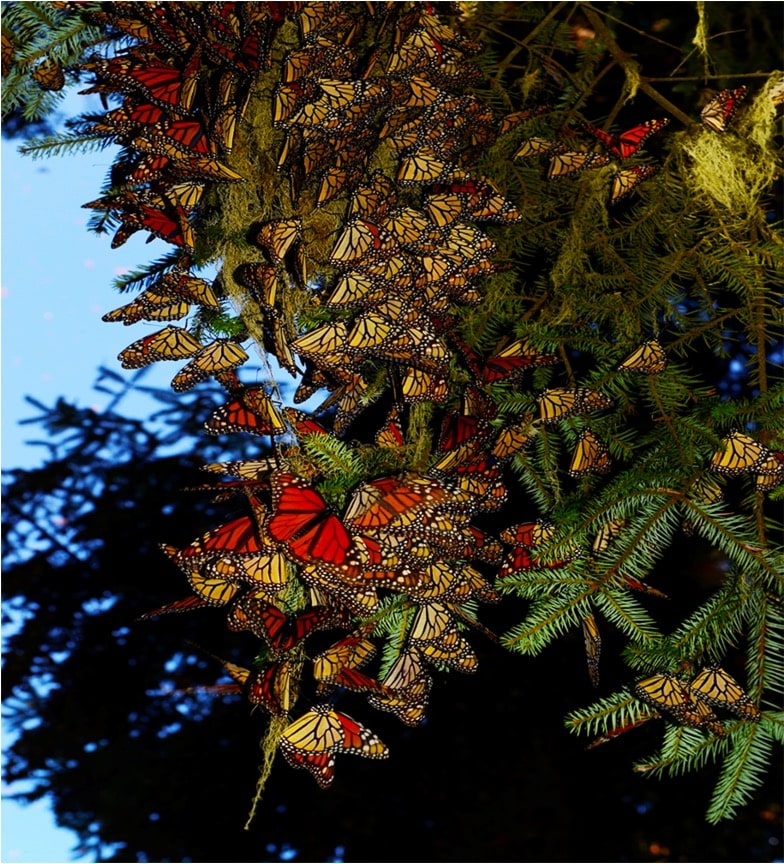
When the Super Generation finally arrives in Mexico, it goes into a state of semi-dormancy and spends the entire winter clustering for warmth on oyamel fir trees. At the beginning of spring, the Super Generation flips the juvenile hormone switch to normal and starts a reverse commute back to Canada. A perfect illustration of the “Sleepy Transformation” or Danaus Plexippus, monarchs’ Latin name.
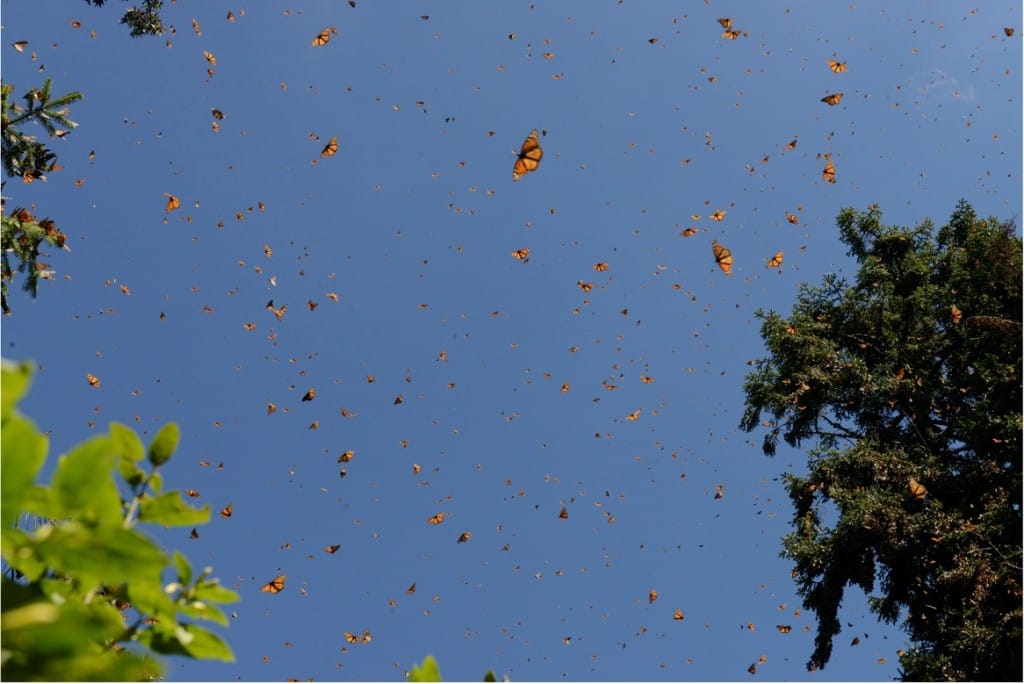
This spectacle of millions of monarchs floating in the air or cloaking several acres of forest in orange is one of the most astounding natural phenomena in the world and is a “bucket list” sight for nature lovers.
On the western side of the Rockies, overwintering sites for monarchs migrating from Western United States are not as dramatic. However, there are hundreds of them and the most significant ones are on the coast, within driving distance of Napa. Check the Xerces Society’s map of overwintering sites.
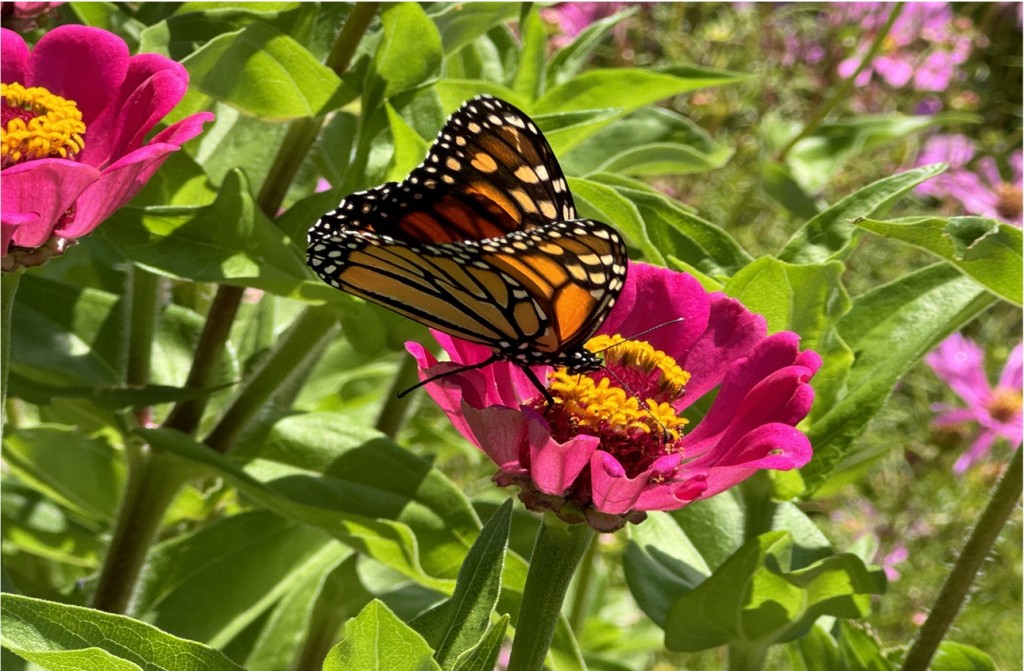
While there are no genetic differences between western and eastern monarchs, there are significant differences in their numbers and rate of decline. Eastern monarchs number in the millions, while last year’s estimate for the western monarch population was 9,000, down from 233,000 in 2023. Since 1980, the western monarch population has declined almost 95 percent.
Climate change, habitat loss, predators and pesticides take a toll on monarchs everywhere. But these factors appear to be exacerbated in the West. The use of neonicotinoids and glyphosate in agricultural areas can weaken monarchs’ immune system and kill them. Drought and fires destroy overwintering and breeding grounds. Pacific Coast real estate developments encroach on milkweed, a plant crucial to monarchs’ reproduction cycle.
To improve this critical situation, the western monarchs need more habitat acres and protection of their overwintering sites—issues requiring action from government, large landowners, and conservation non-profits.
For that reason, the Land Trust of Napa County has planted 1,000 milkweed plants at Sutro Ranch in eastern Napa County. As California wineries continue to reduce their grape acreage, they have an opportunity to plant pollinator-friendly and tourist-enticing flowers such as lavender, California natives and even milkweed.
But what can we, backyard gardeners, do beyond planting a garden? As it happens, quite a bit.
Volunteer involvement is crucial to academic research and conservation programs. Many research publications use data collected by citizen scientists. To learn about volunteer opportunities, browse the websites of the Xerces Society and Monarch Joint Venture.
A few examples of such projects:
Western Monarch Milkweed Mapper records sightings of milkweed and monarchs at any stage. You can report your own observations while on a nature walk using your phone and the iNaturalist app.
Southwest Monarch Study tags monarchs for the purpose of understanding their migration and breeding patterns. This important program is the only one of its kind authorized in California as state law prohibits rearing and handling monarchs. Participants need special training.
Western Monarch Count is a seasonal count conducted on Halloween, Thanksgiving and New Year’s Day. Personally, I cannot think of a better way to spend at least part of these holidays, being outdoors with beautiful creatures that desperately need our help.
And finally, don’t just plant a pollinator garden. Up your game and register your garden as a Monarch Waystation or a Certified Wildlife Habitat. Then display your conservation plaque for all to see.
If we believe that monarchs are nature’s royalty worth saving, then let’s help them stay in power!
Library Talk: UC Master Gardeners of Napa County with Napa Public Library will host a free talk on “Beautiful and Protective Firewise Landscaping” on Thursday, Aug. 7, from 7 to 8 p.m. via Zoom. Learn how to make your home more firewise and how to landscape with fire safety and resilience in mind without sacrificing beauty. Note that the meeting will not allow entry after 7:15 pm. Register to receive the Zoom link.
Workshop: Join UC Master Gardeners of Napa County for a workshop on “Cool-Season Vegetables” on Saturday, Aug. 9, from 10 a.m. to noon, at UC Cooperative Extension, 1710 Soscol Ave, Napa. Now is the time to plan for a harveset in fall, winter and early spring. This hands-on workshop will help you understand which vegetables thrive in cool or even cold weather and why you need to start planting while the weather is warm. Register here.
Tree Walk: Join UC Master Gardeners of Napa County for a docent-led tree walk of Fuller Park in Napa on Sunday, Aug. 10, from 10 to 11:30 a.m. Historic Fuller Park is an arboretum with many exotic and native trees planted over the past 120 years. Meet at the corner of Oak and Jefferson Streets in Napa. Registration required.
Help Desk: The Master Gardener Help Desk is available to answer your garden questions on Mondays and Fridays from 10 a.m. until 1 p.m. at the University of California Cooperative Extension Office, 1710 Soscol Ave., Suite 4, Napa. Or send your questions to [email protected]. Include your name, address, phone number and a brief description of the problem.