The Loose Cannon: Murder trial of a Yountville mayor

Editor’s Note: In August 2024, Ranndy Pina’s column titled “The 1st Prohibition” chronicled town news stretching from 1906 to 1969, beginning with a tough situation with the California governor in 1905: “Governor Pardee has signed the bill prohibiting the sale of liquor within a mile and a half of the Veterans’ Home at Yountville.”
Pina wrote that some in Yountville at that time likely used methods, legal and perhaps not, to continue liquor sales over the years. He then explained, “Prior to the end of prohibition, the Cullen–Harrison Act, effective April 7, 1933, legalized the sale of beer with an alcohol content of 3.2% and wine of similarly low alcohol content, thought to be too low to be intoxicating.”
The May 16, 1968 issue of the Napa Valley Register reported, “The usually affable Mayor of Yountville hurls a tough challenge at state assemblymen, their legislative committees, the state liquor control board and the governor himself Wednesday. What got Mayor John Lloyd’s dander up was a bill, recently introduced in the state assembly, that would put an end to the sale of beer [3.2%] in this quiet, grape growing, often hot and sometimes thirsty Napa Valley community of about 6,000-5,500 of them billeted at the nearby California Veterans Home.”
Then in the March 6, 1969, the Register wrote, “Mayor sees growth if law stricken – Many millions of dollars will be invested in this community in the next five years,” said Yountville’s Mayor John Lloyd, “as soon as we abolish the liquor regulations on Yountville.”
Lloyd was successful in this effort and appeared to be well respected and liked in the community. Keep that in mind as you read this column.
My 50th Loose Cannon column begins with a 50-year-old picture:
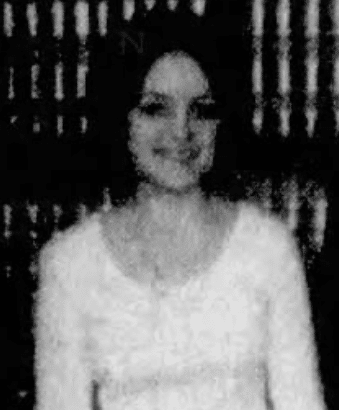
Recognize this cute young lady?
She lives on Washington Street and played an important role in a Yountville murder trial.
A judge once described her as, “the person who taught me how to be a judge.”
On her first day of school, she became the first kid to be thrown out of the school’s kindergarten because she swore at the teacher in Spanish, not knowing the teacher understood Spanish.
I’ll tease you with those lead-ins to suggest you read her profile in the Oct. 8, 1998 edition of the Yountville Sun.
Not included in her profile, however, was her role in a murder trial that involved a former Yountville mayor. As is my writing style, I planned to mislead you all into thinking a former Yountville mayor had been murdered. That would have been interesting, but the real story is even more interesting.
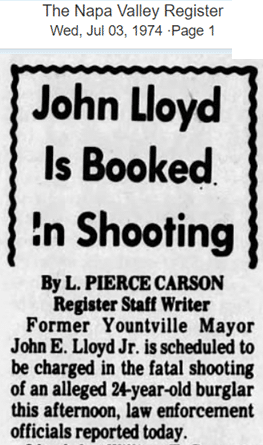
The article went on to quote Lloyd as saying: “I did it, I shot him.”
In the days and months that followed there were conflicting reports, from different witnesses and Lloyd, of what happened that evening. I will do my best to provide a summary of the reports using information from different sources from the day of the incident up to the final verdict. I do not have the space to provide all the reported versions and evidence provided during the trial.
According to Lloyd, earlier in the evening, he had spotted two young men acting suspiciously and called the Sheriff’s dispatcher, asking that they send somebody to talk to the young men.
When the dispatcher told Lloyd that no units were available, LLoyd told the dispatcher to log the information and that because of the suspicious nature of the young men, he had his gun. He said they had gone across the street to the Two Spot bar (the current Pancha’s).
Later, he drove by and found the two men trying to break into the Coke machine at his Lloyd Brothers Service Station.
Lloyd confronted the two men and told them to stay put. One man (Schmaus) ran away and the other (Casey) drove off in a VW sedan. Lloyd took pursuit in a pickup truck with a camper, firing warning shots out his window (take a moment to picture that chase). The chase went from Webber Street to Yount Street to Yount Mill Road, and then back to Yount Street. where the altercation took place.
There are vastly different versions of the altercation, so I’ll only say this: The two men struggled, and Lloyd’s .25 caliber pistol discharged, hitting Casey in the back of the head. Casey went into a coma, never regained consciousness, and died a few hours later.
On July 9, 1974, John Lloyd was arraigned on murder charges. Lloyd retained attorney Homer Jones to defend him.
Lloyd’s preliminary hearing was postponed to October at the request of Jones to prepare a complete defense. Jones felt that the charge could be reduced or dismissed entirely.
On Jan. 21, 1975, jury selection was completed in one day, with five women and seven men selected.
On Jan. 23, opening arguments were made, and defense attorney Jones was successful in getting Casey’s past criminal record admissible as evidence.
According to the Napa Register, Assistant DA John Cooley accused the defense of fabricating a “smokescreen” and went on to say, “What he (Jones) wants to do is say it’s all right to kill a doper or a crook or something else.”
On Jan. 30, Lloyd took the witness stand. He said that during the struggle, he tried unsuccessfully to knock Casey unconscious. When that didn’t work, he fired a warning shot into the ground. The struggle continued and Lloyd attempted to use his gun hand to tighten his head lock on Casey and the gun discharged.
The next day, Lloyd was grilled by the prosecution for two hours, but his testimony stayed consistent with earlier testimony. Assistant DA Cooley cast doubt on Lloyd’s account of the shooting. He stated that three witnesses did not see a struggle before hearing the fatal shot.
On Feb. 4, both the prosecution and the defense gave their closing arguments. From the Napa Valley Register of that day, Assistant DA Cooley said, “Essentially, what you are going to decide here today is whether or not we are going to return to the vigilante system of justice.”
Defense Attorney Jones said, “The law recognizes, as it must, that accidents do happen. And as long as there is no evidence of evil intention.”
Lloyd could not be found legally negligent.
Jones went on to say, “Are we trying to make the streets safe for criminals? Is that what we are about?” Jones said that would be the effect of any guilty verdict.
Before the verdict was returned, Jones was nervous and doubted the case would go his way. Anita Solis, his young legal assistant, believed they would win and did her best to calm and convince him so.
On Thursday, Feb. 6, after two days and 14 hours of deliberation, the jury returned a verdict of “Not Guilty.”
Friends and relatives of Lloyd mobbed him after the verdict was read.
Casey’s mother sobbed and was later assisted from the courtroom by a sheriff’s deputy.
Anita always believed in Lloyd’s innocence but was relieved when the verdict was read. Just the same, Anita wept along with Casey’s mother.
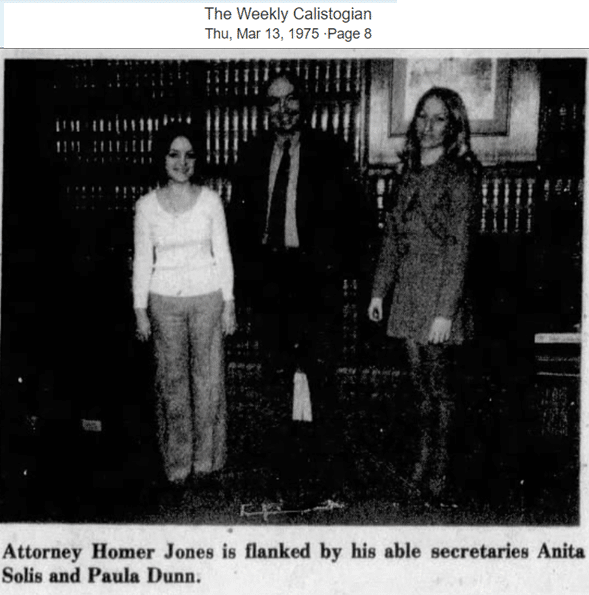
Following the Not Guilty Verdict
Anita Solis was a young legal assistant to Attorney Homer Jones in 1974 when John Lloyd walked into her office. She had known John Lloyd for years and was surprised to see him and learn of his arrest for murder.
When I talked with Anita Solis while researching my “Yountville Murder Trial” column, she shared that she took some heat from some locals for helping defend Lloyd in her role as Jones’ legal assistant. She did not choose the case and was just doing her job to the best of her ability. Even though those folks made her uncomfortable, she never considered quitting.
Indeed, there was some dissension about the verdict of the trial even within family members. I received this response from one of my readers:
“Interesting. I remember that case quite well. In particular, I remember how angry my mother was when John was found not guilty. The Lloyds were friends of my grandparents, and they were overjoyed with the verdict. Most folks in town whispered behind their hands what my mother said out loud. Good old boys and BS were commonly heard. Good read, thanks.”
Sponsored
Author