
The Loose Cannon – Wind Machines 101

Without a doubt, my sister-in-law Rickie has one of the highest IQs of those that carry the Piña name. Among her many accomplishments, she was the chief financial officer at Silver Oak Cellars for many years. But when my late brother John (RIP) first brought her into the Napa Valley, she noticed the wind machines and asked what they were. She believed John when he told her (straight faced) that they were fans that we turn on in the summertime to keep us cool.
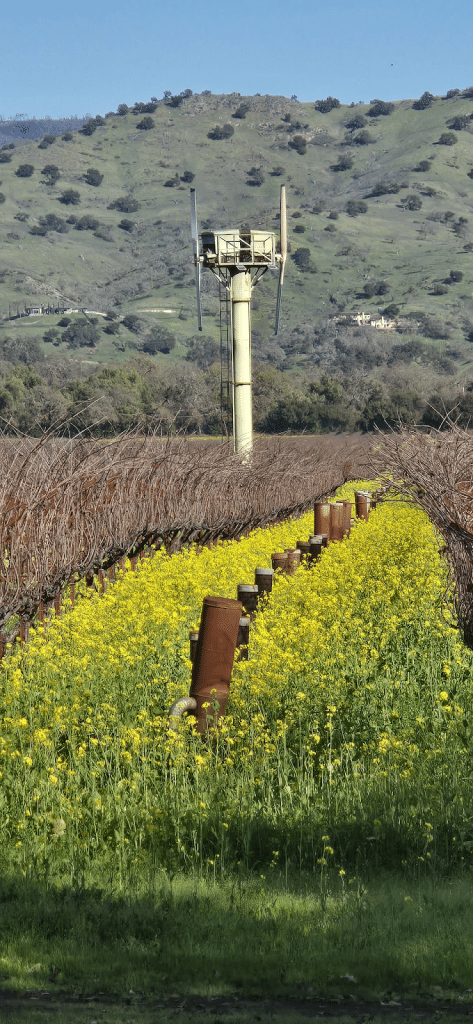
Chances are, if you live in the valley, you’ll be hearing these machines running in the coming months, often at times you don’t want to hear them running. There are many stories of visitors asking why helicopters were hovering overhead through the night.
I’m guessing most people living in the valley know that the wind machines are used for frost protection in the vineyards, but maybe not how they do that.
I’ll explain how wind machines work to prevent frost and also under what conditions, they don’t. This will be a short course that only explains the basics.
Richard L. Snyder, extension biometeorologist, Atmospheric Science, UC Davis, said, “More economic losses occur due to freeze damage in the United States than to any other weather related hazard.”
Frost Types
Advection frost
An advection frost occurs when cold air blows into an area to replace warmer air that was present before the weather change. It is associated with moderate to strong winds, no temperature inversion and low humidity. Advection frosts are difficult to protect against, but fortunately they are rare in California fruit-growing regions.
Radiation frost
Radiation frosts are common occurrences in California. They are characterized by clear skies, calm winds and temperature inversions. Radiation frosts occur because of heat losses in the form of radiant energy. Under clear, nighttime skies, more heat is radiated away from an orchard or vineyard than it receives, so the temperature drops. The temperature falls faster near the radiating surface causing a temperature inversion to form (temperature increases with height above the ground).
I’ll limit this discussion to the two types of frost previously noted: advection and radiation. For ease of explanation, following are some pictures, provided by Iowa State University. Just pretend that those trees in the graphics are really grape vines.
First, the radiation freeze:
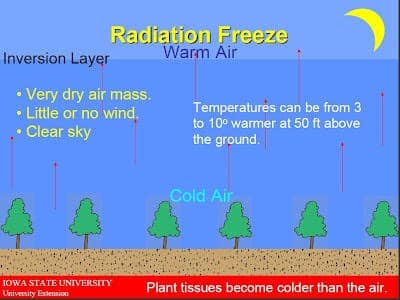
The radiation freeze is a condition that can be mitigated by the use of wind machines. Since there is “warmer” air above the vineyard, the challenge is to bring that air down to the vineyard.
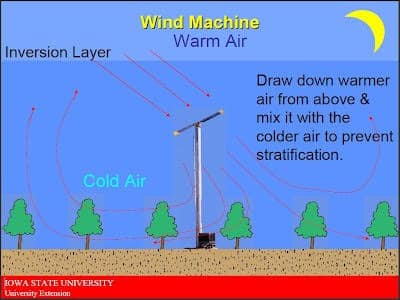
The use of wind machines can perform that function.
In an advection freeze, however, there is no warmer air to bring down.
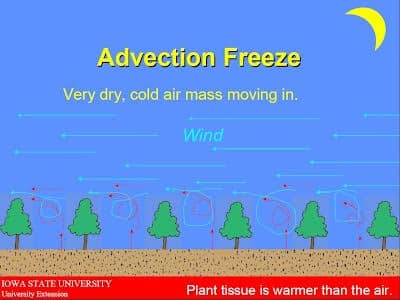
Operating a wind machine during an advection freeze could actually do more harm than good.
Many of the current wind machines are equipped with thermostats that automatically start the machines when the temperature gets low enough. But in my early years with the vineyard management company, we drove around and monitored the vineyard thermometers for hours before manually starting the machines.
When it finally got cold enough, I’ll admit that I took a perverse pleasure in firing up the wind machines in the early morning hours and watching house lights come on. My belated apologies to Paul and Susie Frank. (The Franks started Gemstone Vineyards, which was managed by Piña Vineyard Management.)
But even with the wind machines that automatically start when the temperature gets low, they still must be monitored. We had a case where one of those machines did not start when it was supposed to. Turns out the day before, when the propane tank was refilled, the delivery driver shut off the tank valve to refill it, then forgot to reopen it.
Also visible in that vineyard picture are smudge pots, also known as orchard heaters. The base of the pots held a burnable fuel (diesel, kerosene, used motor oil, etc.) and when lit, they functioned in unison with the wind machines to raise the temperature at the ground level.
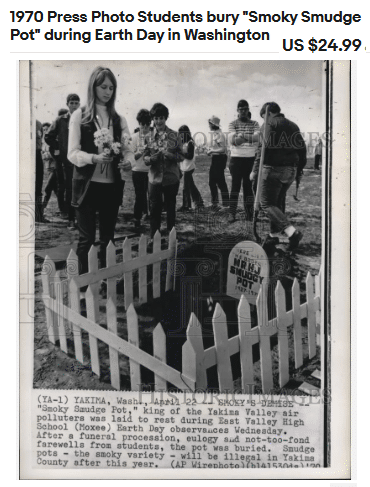
Years ago, they were quite common in Napa Valley vineyards. Not so much anymore, and I can’t recall the last decade that I even saw them in use in the vineyards. It was a spectacular sight to see hundreds of these smudge pots glowing in the vineyards on a frosty night. That was the enjoyable part of their use. The downside was the pollution they created, and the evidence of that was visible when blowing your nose the next day. Not a pretty sight.
For that reason, there was resistance to their use as evidenced by this photo available on Ebay:
This YouTube video shows a long row of “retired” smudge pots/orchard heaters:
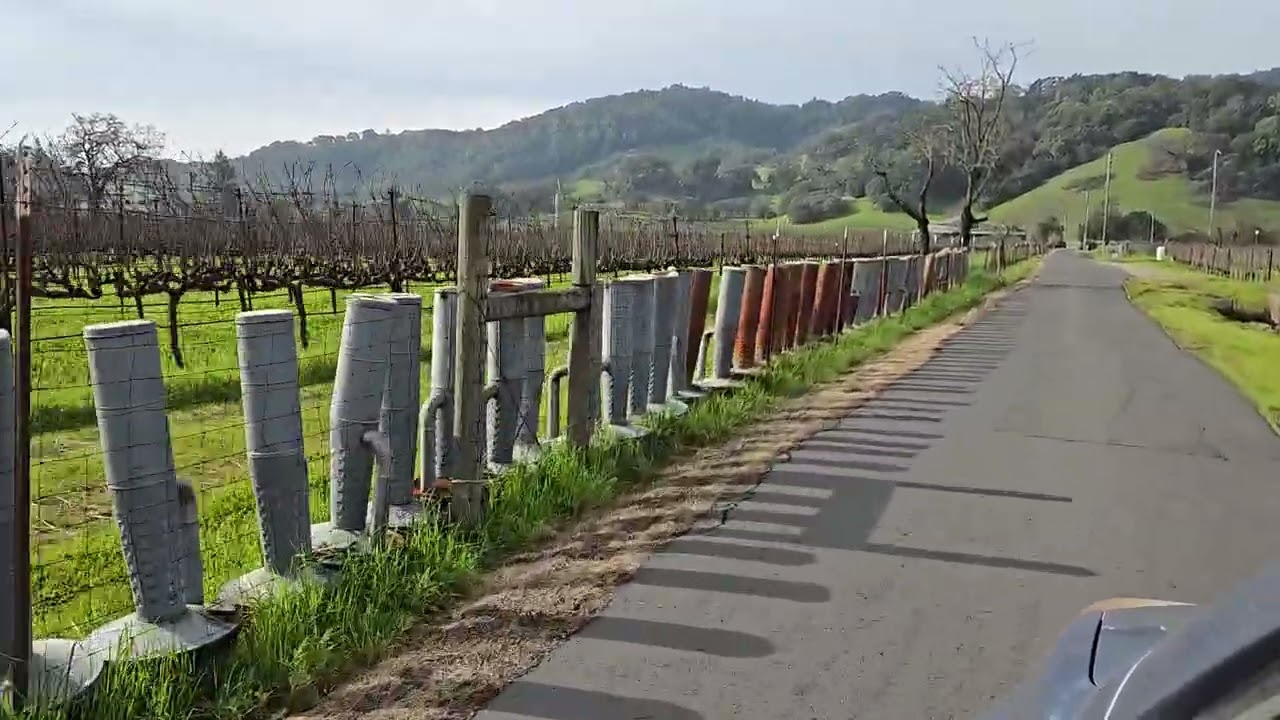
Some of them have been repurposed for other uses such as this campground heater:

Lighting those pots required walking through the vineyards carrying a specially designed lighter to ignite the fuels in the pots.
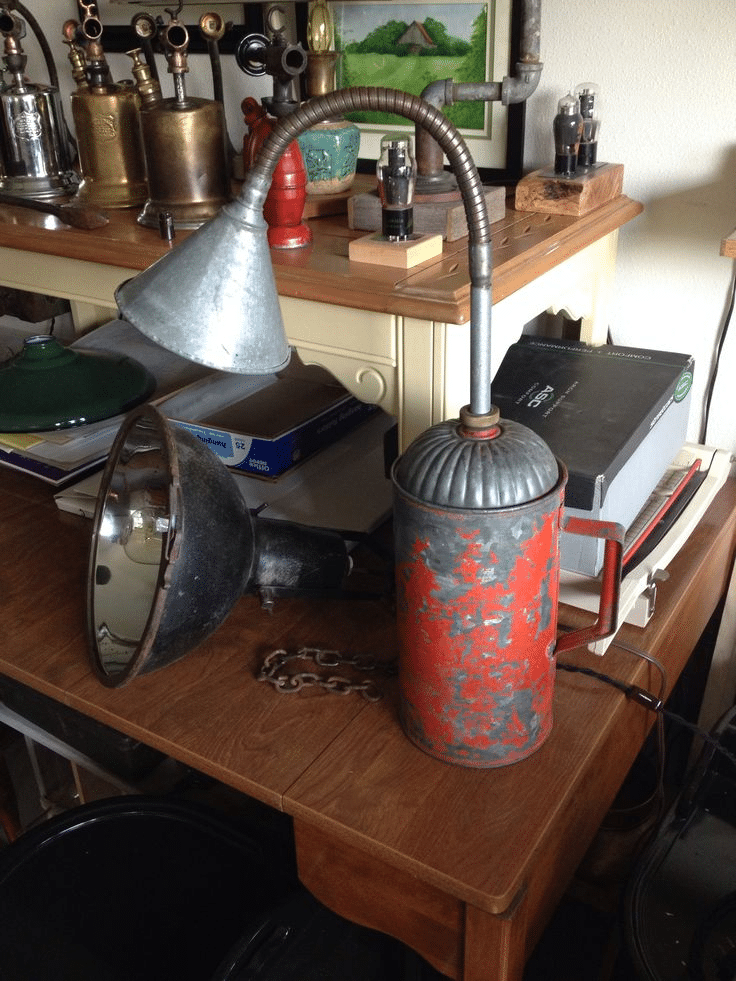
The lighter above has been repurposed as a desk lamp. There used to be a wick (for lighting) at the top of the lighter, where you see the flexible conduit attached. Our lighters carried a mixture of gas and diesel. When inverted, the burning fuel was dripped through a port into the base of the smudge pot to ignite the diesel. For unexplained reasons, I found this job on cold and dark nights very enjoyable. No, I’m not a pyromaniac. I don’t think so, anyway.
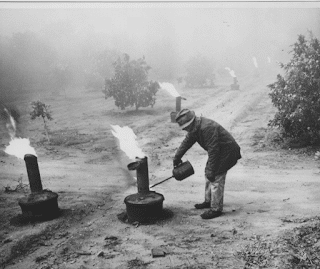
Those lighters were later replaced by propane torches.
The following picture is a smudge pot operating in full glory in someone’s driveway:
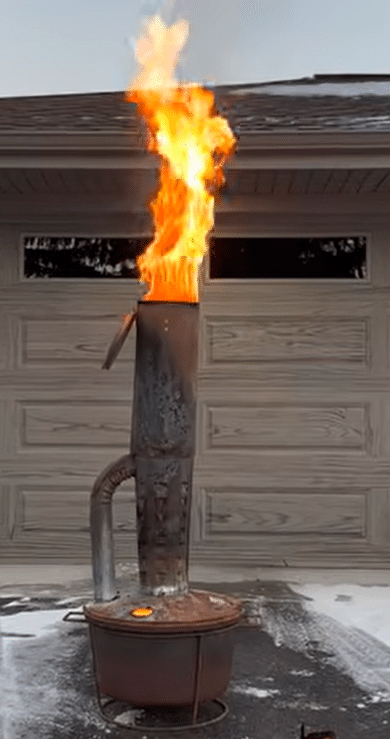
There was a heat regulating gizmo on the pots, but it appears that on this one it was removed for maximum flames and visual presentation.
So, the next time the wind machines wake you up and somebody at the store or your work or gym mentions, “It sure got cold last night,” you might be able to impress them by saying, “Yes, but luckily for the farmers, it was a radiation freeze and not an advection freeze.”
Ranndy Piña
[email protected]
Sponsored
Author