Town Council Meeting overshadowed as vice mayor criticizes fellow councilmember
“If you’re going to call someone out, you should do it with the courage by name”
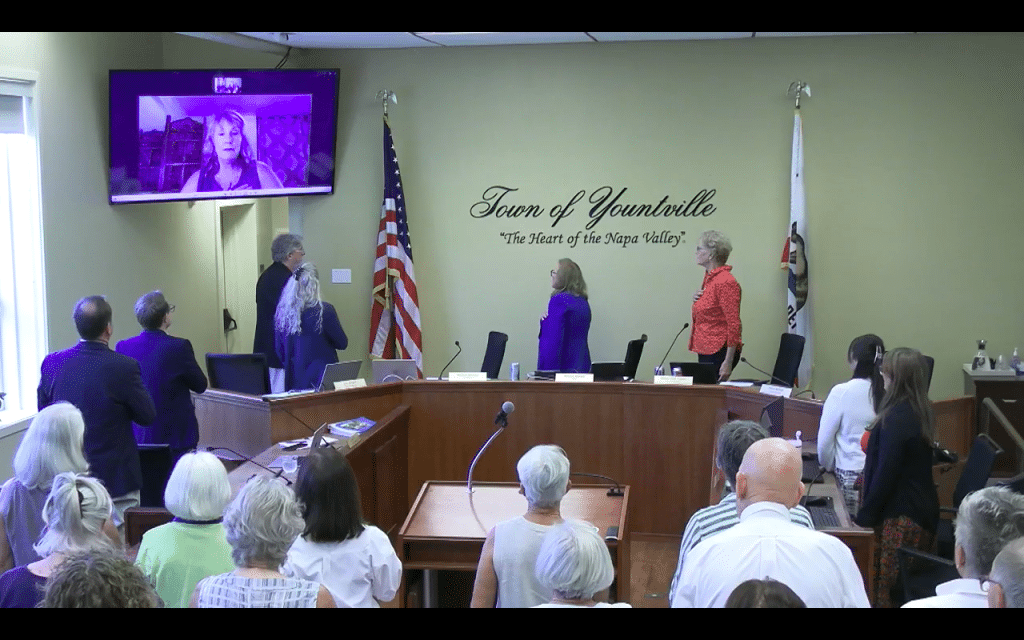
The regular meeting agenda for the Yountville Town Council on July 21 included items such as announcements, proclamations, time for public comment, the consent calendar, staff presentations and informational reports.
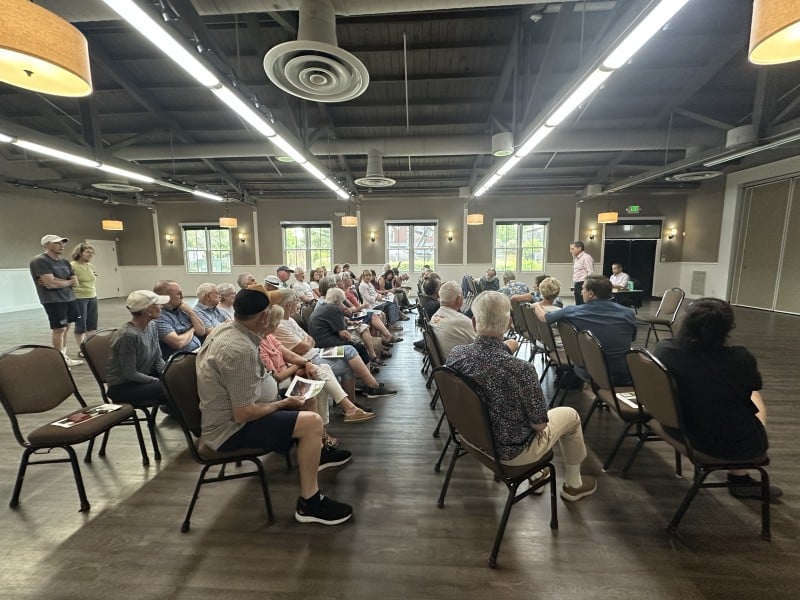
Mayor Margie Mohler, Vice Mayor Pam Reeves and Councilmembers Eric Knight and Hillery Trippe attended in chambers, with Councilmember Robin McKee joining remotely via Zoom. The seats in the galley were filled with close to 35 people attending.
Vice Mayor Reeves’ speech
Prior to the public comment portion of the meeting and not on the agenda, Reeves announced that she wanted “to begin this meeting with a statement of some of the accomplishments of this council on staff, with input from our commissions, over the last three-plus years” before going on to list the many projects and accomplishments of the current council and town staff.
Amongst many, she noted the installation of the town barbeque, shade structures, a water tank, the $250,000 federal microgrid grant from Congressman Mike Thompson, reimagination of Yountville Days into Mardi Gras, the establishment of the Yountville Entertainment Zone, and several public benefit uses now at the Commons, including the Coop, community garden, Locals Lounge, dog park and Yountville Fit. She pointed out that while the “housing project has been put on hold, the property still provides many benefits to town residents.”
Her comments then shifted into a secondary topic. “We are not professional politicians. We rely on other community members and on our boards and commissions to advise us. But the heavy lifting is done by our staff and sometimes by consultants and contractors. We listen and gather information and hold public meetings. We are residents first, and your neighbors. We are people who enjoy making good things happen for the community.
“I will finish by addressing those who have been so aggressive in faulting this council’s actions,” she continued, defending the intelligence and integrity of the council and stating that the purchase of the Commons site was identified by the community and all council members as the highest priority. “To move forward with any project at the Commons, all community input deserves to be heard. Not only the loudest, most recent commenters.”
Citing the referendum that paused the development of the Commons site, Reeves said, “The chaos of the referendum seems now to be an end run to manufacture division at election time. These past couple of months have changed our community.
“A majority of the council members on this dais are committed to the democratic process that centers on public meetings, where all are welcome to participate. I’m saddened that one council member decided to go out of the democratic process.”
In response, Councilmember Trippe asked to speak, stating, “I thank you for the list of accomplishments. Certainly, a lot has been done. This is not, in my understanding, a forum for political speeches accusing people.”
Trippe told the audience, “In case any of you didn’t get it, I am the one that councilmember was referring to, and I actually think if you’re going to call someone out, you should do it with the courage by name.
“What we have had is a vast number of people come forward and state their opinion, and make their opinions known, and they can say it in as loud a voice as they want, and in any format they want, I believe. I’ve been giving this a lot of thought. It is our 250th anniversary in the United States. The First Amendment is my favorite part of the Constitution. That is the foundation of democracy. Democracy is not always about everybody getting along and five people agreeing.
“Everything I said, I said many times in public,” she added, emphasizing that her main point is that democracy is about the ability to assemble freely. “You can assemble in a group where no one else was invited. You can assemble in your house. You can assemble to talk about whatever the heck you want to talk about or just have fun. There is no legal rule that everyone needs to be included or that everybody has to agree with what you say. So, we have the right to assemble, which we have been using and will be using during the election period, and we have the right to freedom of speech and also the right to criticize our government. And I certainly have experienced some of that personally as an elected official.”
Trippe added, “You have not heard me criticize anybody’s way of speaking out about things, their timing, their thoughts, because that is actually democracy. So, I want to stand for democracy and for people being able to voice their concerns about government, and if you don’t think that this has been, in some ways, a positive process, look at the last several council meetings. We have never had, for the most part, in my experience, regularly more than two people show up, and we do now.
“I don’t think it’s appropriate to make speeches during this period, but having been attacked and called out, I do want to represent my point of view and also put in my two cents for the right for all of us to get together, talk about politics, talk about our elected leaders, do it with whoever we want, and invite anybody we want.”
Public Comment
Yountville resident Jill Turner suggested that the previous speech by the vice mayor should have stopped after all those wonderful accomplishments. “That’s a shame that that didn’t happen. It seems like the negative remarks continue, and I think some of you were the ones who are wanting to continue to say negative things about what’s going on. Many of us who opposed some of the decisions that were made are ready to move on. We want to move forward.”
The next speaker, Stephen Becker focused upon the search for a new Yountville town manager. “This is a transition point, very much so for Yountville and for the town council, we will reimagine the Commons. We will reimagine the two imperatives that the town has as property owners of the Commons, and to meet the obligations of the affordable housing that the state requires. It’s also a transition period because of the coming November election, where three of the five members will stand for election. And the job of the of the town council, if I may be so bold, is to look both at the long-term and the short-term needs.”
Becker continued, “With the division that was so clearly articulated by Councilmember Reeves, there is a great deal of revision, and you can leave a legacy as this town council, that the new town council will have to live with, and the town will have to live with. So where am I going with this? Where I am going with this is you should put a pause on, halt, and stop the search for the new town manager.”
He went on to acknowledge that the council has “absolutely the right to select that person, but not every right that you have should be exercised. If you have a long-term vision, if you have a sense of transition and what is ahead for the town, do the right thing here. Halt the search for the new town manager until the elections have occurred and the new town council is seated.”
Staff presentations and informational reports
The budget overview highlighted the general fund’s revenue sources, including transient occupancy tax (TOT), sales tax and property tax
Town Financial Analyst Kyle Batista explained that his online budget demonstration was to show how to go to the town website and access the budget, by directing users to TownOfYountville.com and scroll down to access the “budget” button.
Batista explained that there are buttons for different departments, each with a lot of information, including monthly financial reports. He also encouraged residents to reach out with any questions. “If you’re looking for anything specific, you can always call the town (707)944-885, you can walk through the doors.”
Yountville Planning and Building Director Aaron Hecock reported on the state of housing in Yountville. In summary, the town is currently not on pace to meet its very low income state-mandated Regional Housing Needs Allocation (RHNA) obligation. Less than 10% of the town’s existing housing, is affordable to moderate and lower income households and the town is at risk of losing approximately 20% of its existing affordable housing stock in the next decade.
Hecock reported that median cost of a single-family home in Yountville is $1.35 to $1.7 million, with an annual income required to afford a single-family home ranging from $365,000 – $515,00; the media cost to rent an apartment in Yountville is $2,300 – $3,000 per month.
The median annual low income for a single person in Yountville was reported as $98,700.
Several options and possible outcomes were discussed, including potential properties for development, including vineyard properties, the French Laundry Garden at Washington and Webber Streets, and the “church property” adjacent to the Catholic church at the southern end of town, which Hecock said is in discussion with a developer.
Municipalities are required to meet certain obligations, including realistic development capacity and likelihood of development. There are also consequences of not meeting state requirements that could include decertification, loss of funding and even litigation.
Hecock’s conclusions: the majority of Yountville’s workforce needs housing that is affordable to moderate and lower incomes; the town will likely need to identify new housing sites for meeting future RHNA needs; housing sites available for meeting current and future housing needs are limited.