Fighting back after Ganoderma fungus invades
All the signs were there for some time, but I was too distracted to pay attention. First, the cherry tree (never a robust bearer) began to put forth two cherries per season. Next, I started to notice a healthy crop of mushrooms after every rain at the base of the same tree. Finally, last March, I discovered my old familiar Ganoderma fungus adorning the trunk of the same tree.
Some of the fungi were mature looking, but new ones were iridescent in the sun. That’s why their Latin name is Ganoderma lucidum, relating to light. They looked terrifyingly healthy, too. But the tree was certainly dead.
After the usual discussion with my husband (Him: “How do you know it’s dead?” Me: “Remember the willow tree last year?” Him: “How do you know it’s dead?”), I had it whacked down, leaving a stump flush with the soil. What next?
The tree was dead; the fungus was very much alive. It had thoroughly invaded the tree’s tissue, which includes roots. I wanted to clean it up as much as possible so I can plant something else in its place.
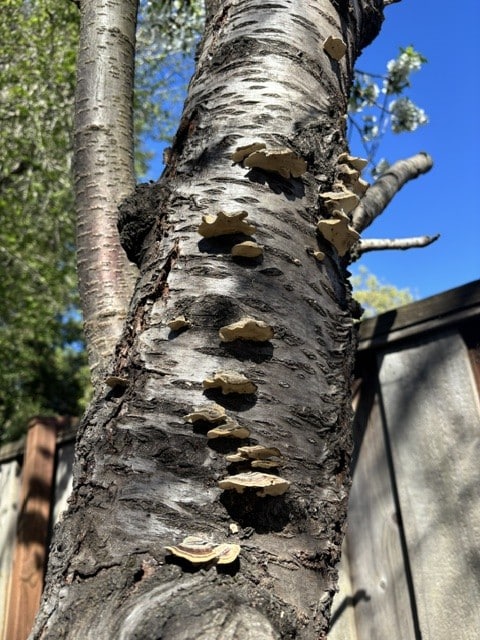
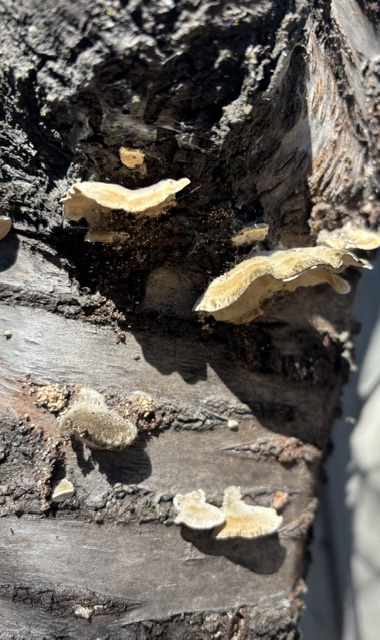
There is no cure for Ganoderma, which is a resilient, opportunistic fungus that attacks the heartwood of a tree, usually by way of damage to the bark. Once you see it on the trunk of a tree, it’s too late. The plate-like projections are actually the fruiting bodies of the fungus that is busy inside the tree, killing it. They are called conks.
Cherries, apples, oaks, even pine trees are susceptible to Ganoderma. In the forests the Ganoderma fungus has a purpose—it encourages tree decomposition—but it’s destructive in the garden.
There are two ways to get rid of Ganoderma fungus: toxic and nontoxic. If I were the desperate owner of a Malaysian palm oil plantation, where Ganoderma is running rampant, I would try anything, even chemical fungicides. However, for a backyard frequented by adult and infant humans, birds, butterflies, bees, squirrels, dogs, feral cats and the itinerant possums, raccoons, skunks and rodents of Old Town Napa, nontoxic is the only way.
My research turned up all sorts of safe remedies, including hydrogen peroxide, cinnamon and baking soda, only there were no specific amounts or concentrations. However, I also learned about solarization of the soil from The New Sunset Western Garden Book. Solarization is the technique of using the sun to purify your soil.
First, I will have someone sturdier than I am remove what’s left of the stump and roots. Then I will buy some UV-proof 4 Mil plastic sheeting. Next, I will rake up any twigs or rocks that might keep the plastic sheeting from lying flat. Then I will dig a trench around the area I want to solarize. After that, I will soak the soil with water to a depth of 12 inches.
And now for the fun part: I will place the plastic sheeting over the affected area and bury the edges in the trench. The idea is to keep the sheeting as flat as possible on the soil. The sun will heat up the soil—rather like what goes on in a greenhouse— and kill the fungus. Eight weeks should do it. The hottest months of the year in Napa are July through September, so my timing is good.
I will wait until winter to plant a replacement tree, and the winter rains should give me a clue—mushrooms—as to whether the soil has been decontaminated. I will be careful not to poke holes in the plastic, which would defeat the solarization. Incidentally, solarization is an excellent way to kill weeds.
The best way to avoid Ganoderma fungus is not to have it in the first place, meaning practice prevention. This includes sufficient watering to keep your tree strong and healthy. Dig trenches if necessary so you don’t have standing water. Mulch your trees. Clean your pruning tools after every use.
In general, the fungus attacks trees that are in some sort of distress, so take care of them. Don’t scrape them with rakes or run into them with lawnmowers and break the bark. That is the usual way fungi attack trees.
I am in my yard a lot, bird and butterfly-watching, but I didn’t keep an eye on that cherry tree. The Ganoderma was probably brewing for five years. That’s about how long it takes for it to kill a tree. A dead tree is a dangerous tree, too. When it inevitably falls over, it can do a lot of damage.
Workshop: Join UC Master Gardeners of Napa County for a workshop on “Succulents: Out of the Pots, Into the Ground” on Saturday, July 25, from 10 a.m. to noon, at University of California Cooperative Extension, 1710 Soscol Ave., Napa. Learn how to design, plant, and maintain a sustainable garden in your own landscape. Register here.
Library talk: Join UC Master Gardeners of Napa County and Napa County Library for a free talk on “Be a Butterfly Angel” on Thursday, Aug. 6, from 7 to 8 p.m. via Zoom. Learn how to help support our declining population of Western Monarch Butterflies. Register to receive the Zoom link.
Tree walk: Join UC Master Gardeners of Napa County for a docent-led tree walk through historic Fuller Park in Napa on Friday, Aug. 7, from 10 to 11:30 a.m. Discover some of the many exotic and native trees in this 120-year-old arboretum. Meet at the corner of Oak and Jefferson Streets. Space is limited and registration is required for each participant.
Help Desk: The Master Gardener Help Desk is available to answer your garden questions. Use our online Plant Problem Help Form or email us at [email protected]. Include your name, address, phone number and a brief description of the problem. You can also visit Master Gardeners in person on Mondays and Fridays from 10 a.m. until 1 p.m. at the UC Cooperative Extension Office, 1710 Soscol Ave., Suite 4, Napa.