A Brush with Memory: Artists return to Yountville a decade after creating mural
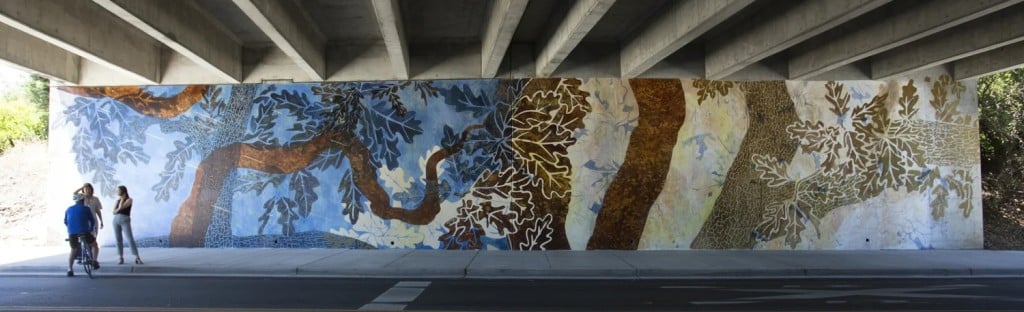
Ten years ago, two artists transformed an otherwise ordinary concrete underpass at the entrance to Yountville into something extraordinary. I recall daily watching the work of art evolve when it was being created in 2016. While driving my then teen daughter to school in Napa daily, both of us would wonder about the project, curious as to what it would depict.
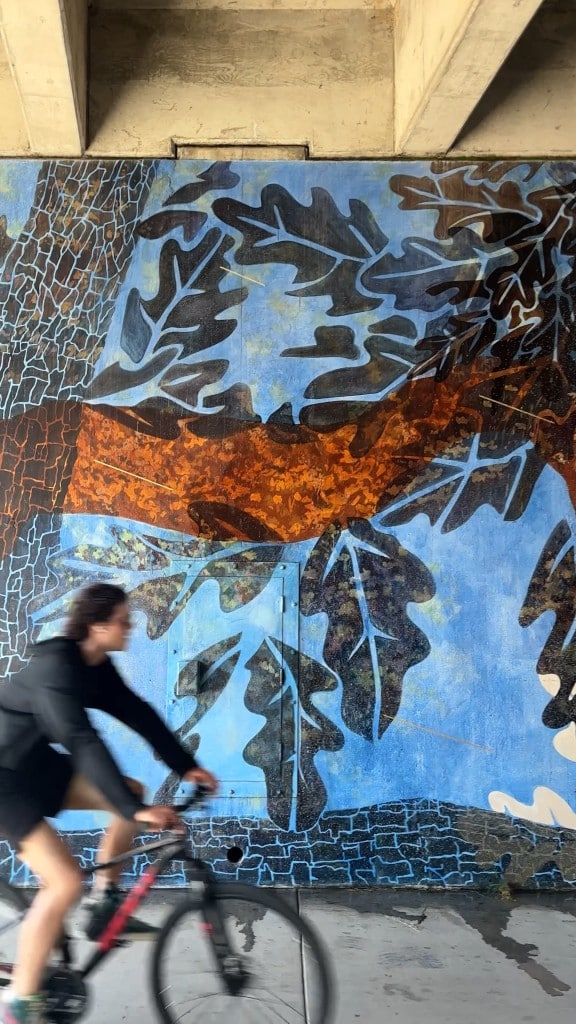
Eventually the mural, a colorful tribute to the majestic oak trees that once dominated the Napa Valley landscape, took shape. Over the years, I have continued to admire that art, both when walking or riding a bike to the golf course, as well as catching a glimpse while navigating to one of the Highway 29 onramps.
In late September, the artists that created the mural returned to Yountville. This time not to create something new, but to lovingly tend to something they had left behind.
For Sofia Lacin and Hennessy Arntzen, longtime friends and the creative partners behind Studio Tutto, restoring their landmark Yountville mural “Memory of a Tree,” became a homecoming as well as an artistic undertaking.
“I really can’t believe it’s been 10 years since we painted this piece,” Lacin reflected during a telephone interview following their visit. “It’s just crazy.”
Located on the concrete abutments of the California Drive underpass beneath Highway 29, the artwork consists of twin 94-foot-wide paintings that have become a familiar sight to residents, visitors and those traveling toward the Veterans Home of California, arriving in or leaving town.
Its sweeping branches, richly layered colors and intricate textures offer a glimpse into the natural history of the Napa Valley, while turning a utilitarian passageway into an unexpected encounter with art.
Although not part of the Yountville Art Walk, the town’s rotating outdoor gallery, “Memory of a Tree” is a prominent and permanent fixture in Yountville’s broader public art collection. Over the years, however, the mural had begun to show its age. Although the town has maintained the artwork, streaks and stains associated with Caltrans repair work on the overpass above had left their mark.
Working with Yountville Parks and Recreation Director Samantha Holland, the artists arranged to return and restore the mural to its original beauty. They arrived prepared for restoration, bringing their paints and supplies, uncertain how much work would be required. What they discovered was somewhat of a pleasant surprise.
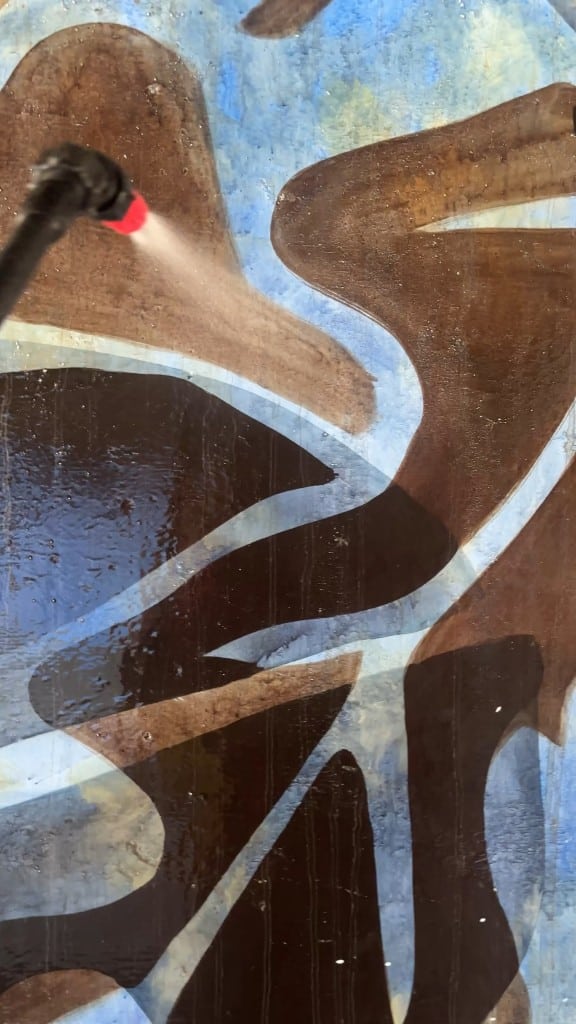
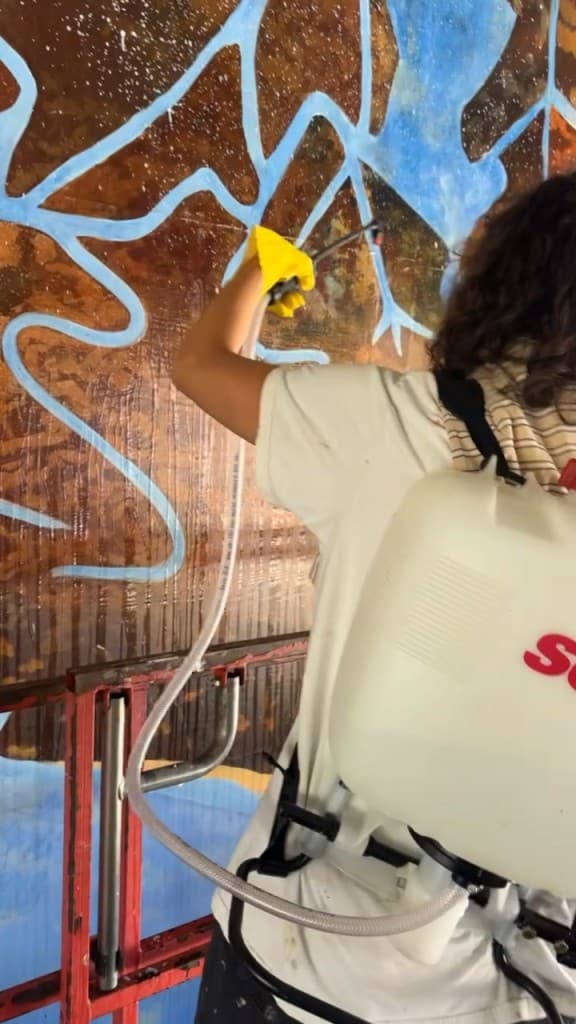
Rather than immediately repainting damaged sections, Lacin and Arntzen began with a decidedly low-tech approach using soap, water, textured sponges and plenty of elbow grease. They carefully hand-washed the entire mural, not once, but several times.
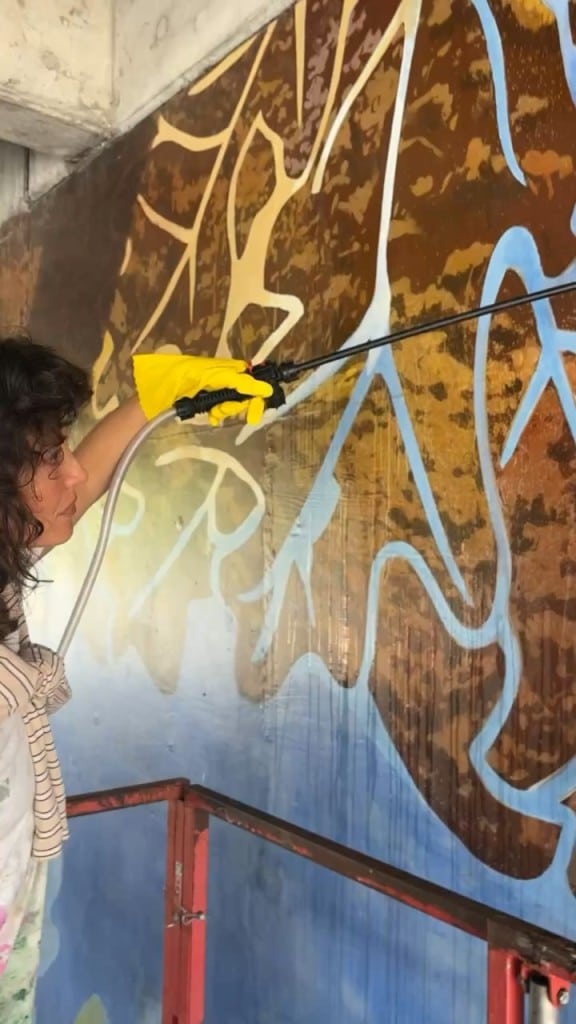
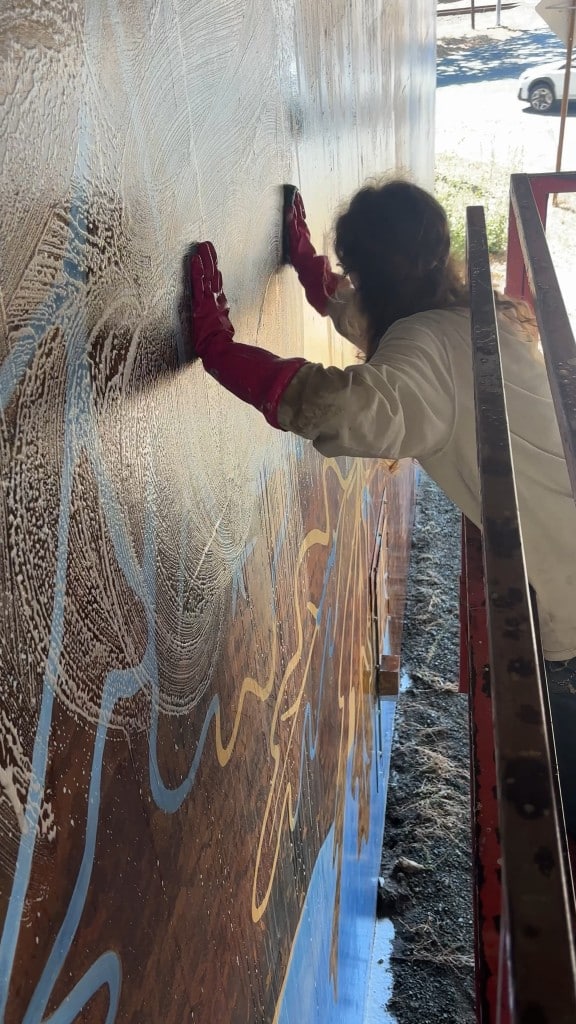
“We brought our whole paint set with us. We didn’t know what to expect,” Lacin explained. “When we got on site, the first thing we tried was basically scrubbing it off.”
Using an initial soap-and-water wash followed by two additional rinses with clean water, the artists gradually lifted years of accumulated dirt and staining from the surface. The process was painstaking. Carrying water in a large backpack sprayer, they worked their way along the mural, carefully controlling the pressure applied to the painted surface.
Their efforts removed or substantially diminished most of the streaking, leaving only a handful of areas requiring minor paint touch-ups. But the physical work brought an unexpected satisfaction.
“There’s something really nice about tending to what you’ve made,” Lacin said. “It’s not always about something new being new. Sometimes it’s about taking really good care of what you already have and bringing it back into its original beauty.”
The artists were equally appreciative of the care the town has given the mural over the past decade, specifically recognizing Holland’s efforts and the town’s ongoing commitment to maintaining its public artwork.
With installations throughout California and projects expanding into other states, the pair know firsthand that not every community is equally attentive to its outdoor art. They described Yountville’s continued stewardship as remarkable, noting that the mural has been regularly cleaned and maintained since its installation.
“Memory of a Tree” is far more than a decorative addition to a concrete wall. Its inspiration reaches back to the Napa Valley landscape before vineyards became its defining feature, when native oak woodlands covered much of the region.
The artists envisioned the underpass as a shaded oak oasis, honoring a species that plays a vital role in California’s native ecosystems. Arntzen explained, “We wanted to transform that space into an oak-shaded oak oasis and really celebrate that species that’s so critical.”
The oak is considered a keystone species, supporting a complex web of plants, birds, insects and wildlife. Its presence is essential to the health and biodiversity of California’s native landscapes, she said.
For the artists, the mural was an early expression of what would become an increasingly central theme in their work: using art to reconnect people with the natural world. “We’ve always really looked to nature for inspiration,” Lacin said. “But about 10 years ago we started becoming more aware of the extreme need to help people connect with nature in an effort to protect it.”
Today, the two describe themselves as environmental artists, creating murals, sculptures and other public installations that reveal relationships within nature that might otherwise go unnoticed. Their goal is not simply to make something beautiful, but to encourage curiosity and a deeper appreciation for the ecosystems surrounding us.
“We’re still very proud of that piece,” Arntzen said of the Yountville mural. “We share it often. A piece that’s honoring the oak tree is very much in line with our values as artists and what we want to get out into the world.”
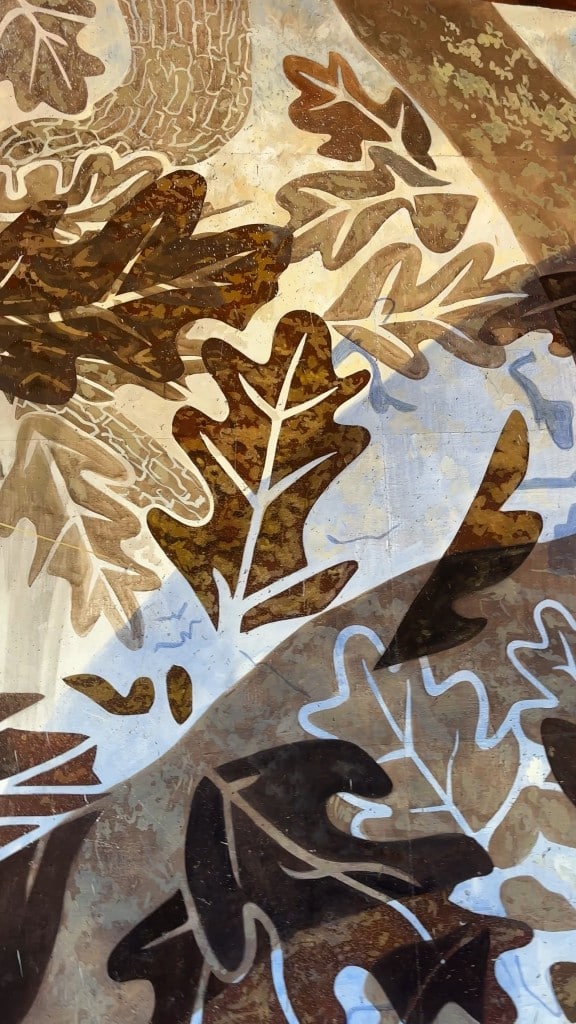
While many people experience “Memory of a Tree” in passing, its creators hope the mural encourages a closer look. From a distance, the work presents an expansive, almost dreamlike vision of an oak tree. Up close, however, it reveals a remarkable complexity of colors, textures and carefully applied layers.
Returning after a decade gave the artists an opportunity to rediscover the intricacies of their own craftsmanship. They recalled the painstaking effort required to achieve the mural’s distinctive palette, including rich indigo and purplish-blue hues contrasted against deep, earthy browns.
The colors were not chosen casually. “We put so many delicate sheer layers on that wall,” Lacin recalled. “The colors, when you really look at them, are so not what you expect to see in a public art way. They’re kind of more what you expect to see in a studio canvas painting.”
Unlike murals created primarily with spray paint, “Memory of a Tree” incorporates subtle tonal variations and carefully layered applications intended to evoke the richness of traditional painting.
The artists believe these details influence not only how the mural looks, but how people feel when experiencing it. Lacin likened the effect to the difference between entering a room illuminated by candlelight and one filled with fluorescent lighting.
The physical space may be identical, but the emotional experience is entirely different. “We’re trying to make candlelight happen everywhere,” she said.
It’s a philosophy that extends well beyond the Yountville mural. For Lacin and Arntzen, the importance of public art lies partly in its accessibility.
Unlike a museum exhibition or private collection, a mural belongs to the everyday landscape. People encounter it while walking their dogs, riding bicycles, traveling to work or simply going about their lives. And those encounters, the artists believe, can have a profound effect.
“Bringing such care and attention into public space could not be more important, especially now,” Lacin said. “I think it helps people feel taken care of and seen and appreciated to have beautiful public spaces.”
She pointed to the contrast between walking through a neglected tunnel and one transformed by thoughtfully created and maintained artwork. The experience, she explained, can subtly influence a person’s mood, outlook and sense of connection to a community.
“Human beings are responding in subconscious ways to our environment,” she said. “I don’t think we realize how much impact our environment has on our psychology and our mood and our perspective.”
Perhaps most importantly, she believes art should never be reserved for those who frequent galleries or collect paintings. “You don’t have to be some art collector. You don’t have to be a gallerygoer and know what the hot new show is,” she said. “You just have to be a regular person walking through a tunnel to deserve art and beauty in your daily life.”
The restoration also offered something neither artist could have anticipated: a reunion with people who remembered them from the mural’s original creation. As they worked, familiar faces stopped to say hello.
Some were residents of the Veterans Home, passing through on mobility scooters. Others were Yountville locals who had watched the mural take shape 10 years earlier. Among them were Jeff Durham and Joey Wolosz, who remembered the artists and said that they still had a framed piece of their work at home.
Another visitor arrived with a black poodle that had been just a puppy when the artists first met the pair a decade ago. Now fully grown, the dog served as a particularly charming reminder of just how much time had passed.
“It was a super sweet reunion,” Lacin recalled. “We had a great time in Yountville, and it just feels really special to be able to come back and take care of the piece.”
For the two artists, whose friendship stretches back to high school, the passage of time has brought plenty of changes. They began creating murals together approximately 17 years ago, eventually establishing Studio Tutto and building careers around large-scale public artwork.
Originally based in Sacramento, the artists who are both now mothers, have spent much of the past decade in Southern California. Arntzen now lives in San Luis Obispo, while Lacin relocated to Ojai following the Altadena Fire in 2025. Their work continues to take them across the country.
What they anticipated might be a complicated repair in Yountville turned into a relatively straightforward, though physically demanding, cleaning that allowed them to spend more time appreciating the mural and reconnecting with the community.
In returning to Yountville, Lacin and Arntzen experienced something that artists rarely can do. They revisited a work they created a decade earlier, encountered people who still remembered them and rediscovered the beauty of their own artistry through the perspective of time.
The mural was still there, its original message intact. But the artists, the people who passed beneath it and the community surrounding it had all changed.
Public art, like the landscapes it celebrates, deserves ongoing attention and care. For residents who have passed beneath the Highway 29 overpass countless times, the freshly restored mural may be an invitation to slow down and see something familiar in an entirely new way.
“We really want to encourage people to stop and look and be curious,” Lacin said, “and let something reveal itself over time.”
Yountville is known for its commitment to public art. “Memory of a Tree” reminds us that sometimes the most impactful art may not be new, but a resident piece of work that is already here.
Studio Tutto photos