
The Loose Cannon: Hidden Strength – Yountville’s Bouchon Restaurant building reveals craftsmanship behind the facade

What a beautiful building!

IMHO, the only improvement would be to lower those hedge heights to see more of it.
Hey folks, I know I promised you more Smitty stories, but I’ve been promised a picture that I need to wait to include with that column. Please bear with me.
Recently, I shared this:
“On my town walk yesterday, I saw the Fiddler On The Roof:
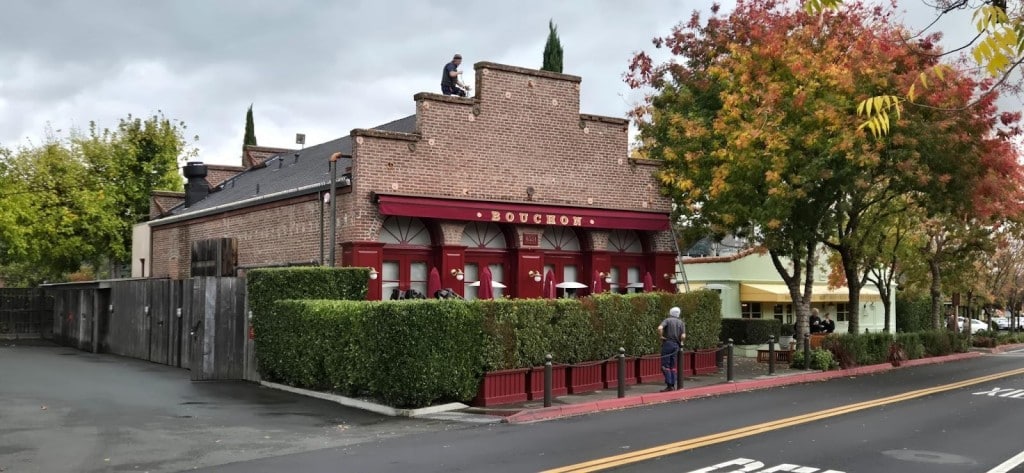
Turns out his paying job is installing holiday lighting.”
But I didn’t share this:
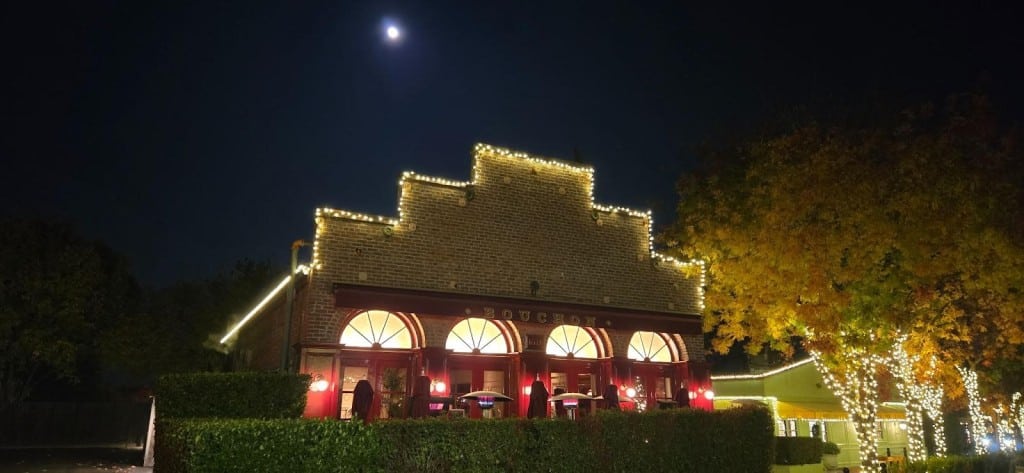
Few Yountville building facades are as impactful as the Bouchon Restaurant.
From my AI Copilot: A facade in architecture refers to the exterior face or frontage of a building, particularly the principal front that faces a street or open space. It serves as a representation of the building’s style and character, encompassing visible elements such as materials, colors, windows and ornaments. The facade plays a crucial role in establishing the visual identity of a structure while also impacting its functionality and structural integrity.
Even structural integrity?
Ever notice those round cast iron plates on the front of the building? They are called anchor plates.
If you noticed them at all, you might have assumed they were just ornamental. But they provide the structural integrity for both the front and back walls. How did they do that?

Those red lines approximate the roof line behind the facade. The plates below the red line are helping to hold the building together. Each one of those plates has a threaded rod going through it that goes the entire length of the building to anchor plates on the backside of the building.

They are structural and prevent the front facade and back wall of the building from bulging outwards during and after construction. They could even help save the structure during an earthquake or if fire gutted the building.
The anchor plates above that red line performed the same function: But their threaded rods only go through the brick facade and were attached to steel bracing on the backside:
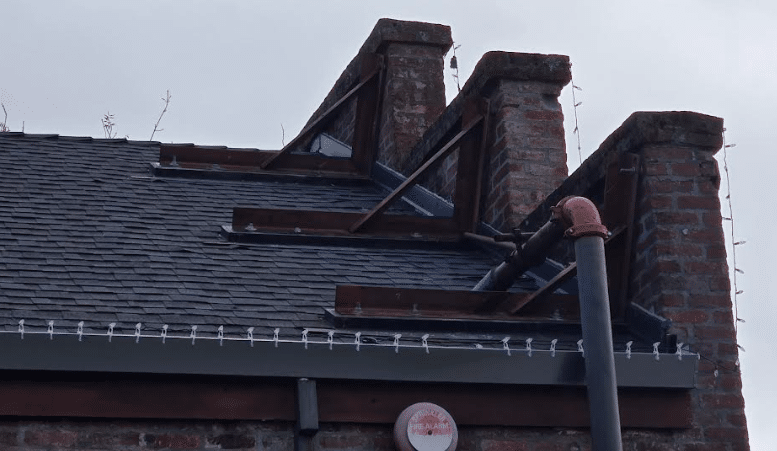
No, it’s not a very attractive sight from that angle, but chances are you never thought to look at it from that perspective.
Anchor plates can be seen at Maison Fleurie in Yountville. The anchors were installed through the steel frame, to provide structural integrity.
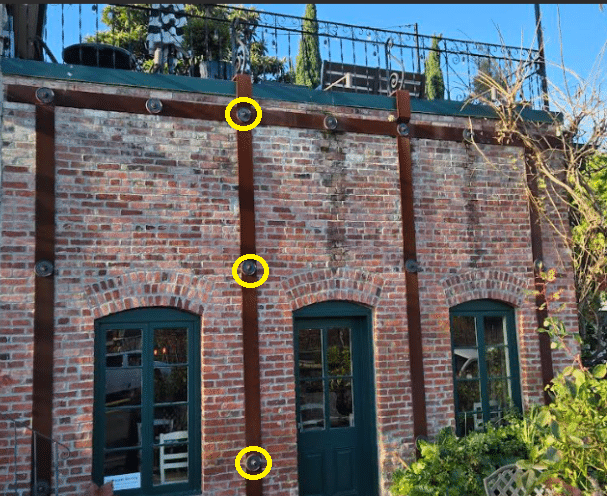
Note the positions of those lower two anchor plates, with the corresponding anchors visible inside that room:
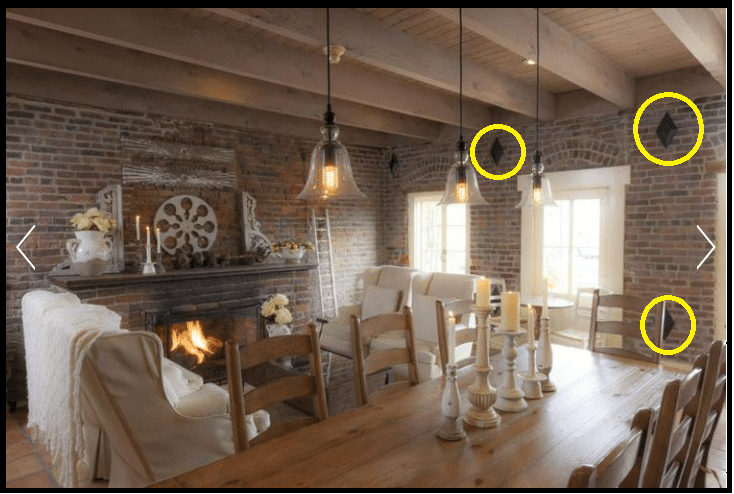
From my limited research, I’d say the most common anchor plates are star-shaped:

After recently spending a month in Texas, I don’t think that the Lone Star state allowed any other design.
But my favorite was this one:

And as I mentioned, some brick buildings were designed to survive fires.
One tactic to help buildings survive fires was cutting the cross beams or joists of a building with a Fireman’s Cut.
From Wikipedia: “In the construction of masonry buildings, a fire cut or fireman’s cut is a diagonal chamfer of the end of a joist or beam where it enters a masonry wall. If the joist burns through somewhere along its length, damage to the wall is prevented as the fire cut allows the joist to fail and still leave the masonry wall standing.
Without fire cut joists, if the burnt joists fail and rotate the unchamfered ends of the joists as they deflect downwards, this would damage the masonry wall at the connection point and possibly pull the wall inwards.”

Having worked in construction for many years, I have an appreciation and deep respect for those old-time builders that did so much with so little.
Consider the ornate “gingerbread” of Beringer Winery’s Rhine House, or Yountville’s Groezinger Mansion, both built in the 1880s.
I was a pretty good carpenter. But those guys were Master Craftsmen!
Ranndy
[email protected]
Editor’s note: Ranndy Pina’s reader Larry Massolo pointed out that the original Bouchon building structure became the blueprint for the Wells Fargo Bank buildings that were built all over the western U.S. Even today, he noted, when traveling through California Gold Country towns, similar buildings still stand and are immediately recognizable.
Sponsored
Author