
The Loose Cannon: Harvest lessons and one memorable wine pairing

This column ends with a story about food and wine pairing, so I did an online search on “When did food and wine pairing start?”
CoPilot gave me this:
“Origins of Food and Wine Pairing – Food and wine pairing is not a practice with a single, exact starting date, but its roots go back thousands of years, evolving from simple, local traditions into the structured ‘art’ we know today.”
That was followed by lots of specific information and details that I no longer have the patience for. My attention span isn’t what it used to be. The summation was all I really wanted to know.
In summary:
- Prehistoric/ancient times: Wine served with food, no formal pairing rules.
- ~6,000–4,000 BCE: Early wine consumption with meals.
- Roman era: First structured course-based wine service.
- Middle Ages: Regional, “what grows together” pairings.
- 18th–19th centuries: Rise of the restaurant and sommelier-led pairing.
- 20th century onward: Scientific and rule-based pairing systems.
Sorting through years and years of acquired files, folders, documents and trash, I came by this 1974 wine order sheet from Louis M. Martini Winery:
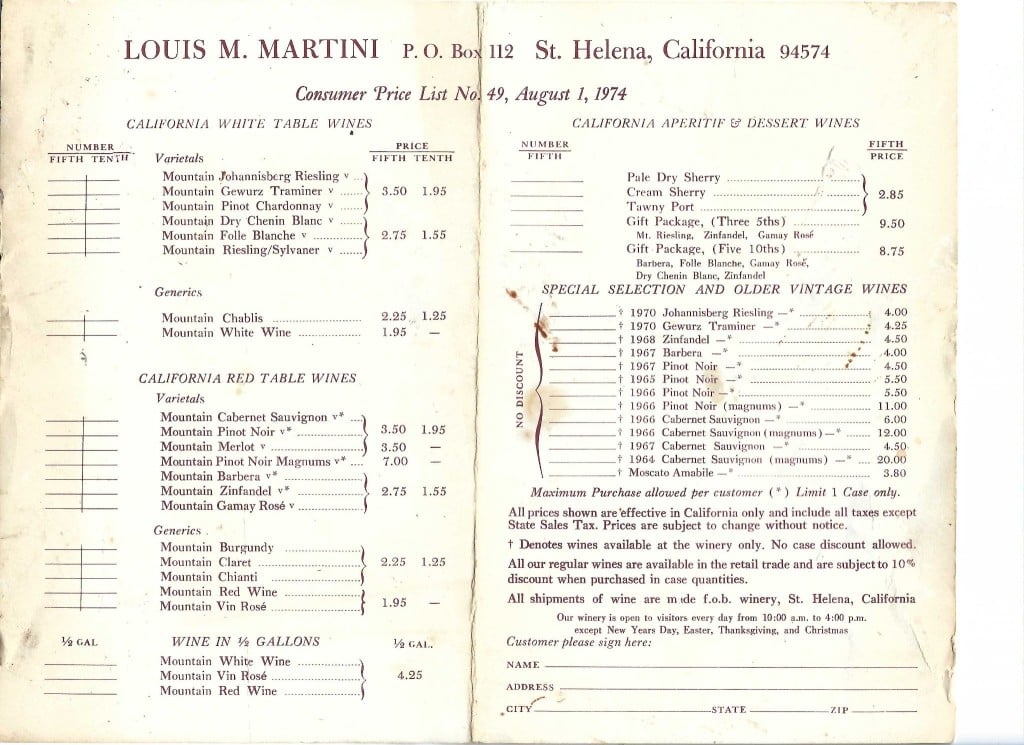
What an amazing variety of wines to choose from, with many offered in tenths (aka splits or half bottles) as well as fifths.
When I was released from active duty in the Army, I landed a summer through fall (harvest) job at Louis M. Martini Winery before returning to Cal Poly (San Luis Obispo) to complete my degree on the GI bill. I would eventually run their mechanical harvester before working as a “cellar rat.” But my first tasks were odd jobs around the winery in preparation for the coming harvest.
Peter Martini had been one year behind me at St. Helena High School, and his grandfather was the founder of Louis M. Martini Winery.
Peter was a fun loving character with a great sense of humor. He enjoyed making people laugh and wasn’t quite as driven to excel in school or take life as seriously as his older siblings. Peter and I worked together a lot that year. His royal lineage did not exclude him from being assigned the same s****y jobs that I was assigned.
At that time, Martini still had several open-top fermenters made out of concrete. I searched and searched for pictures of what they looked like with little success. This is the closest that I could find:
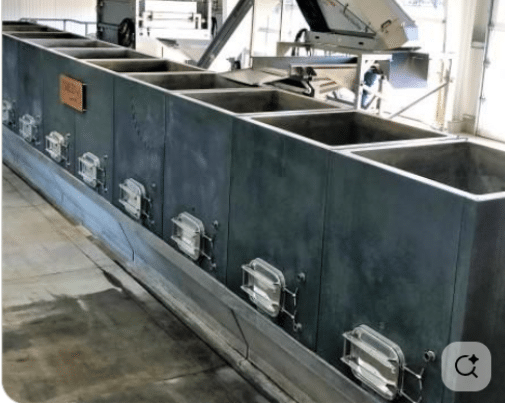
Now bear with me and try to imagine two rows of fermenters facing opposite directions with a catwalk dividing them.
Greg Polverino was the long-time cellarmaster and my boss. When the first grapes were harvested and being fermented, not all the tanks were in use. Greg took me up on the catwalk and pointed out one of the empty tanks. I didn’t know why. Then he led me down from the catwalk and around to the base of that same fermenter. He opened its valve and told me to take a whiff. I did as directed and immediately jerked my head back in response.
The “empty” tank was not empty at all. It was filled with a gas, carbon dioxide (CO₂). Carbon dioxide gas is heavier than air. The tanks on either side of the “empty” tank were fermenting and the invisible gas produced by those tanks was overflowing into the “empty” tank.
Greg had tricked me into learning a valuable lesson. He told me that had I gone down into that empty tank, I would have lost consciousness immediately and died right there.
Then Greg told me a related story dating back to 1901. Two brothers were working at a winery in Antioch. One brother had succumbed to the carbon dioxide gas in a tank before the other brother discovered him. Brother two immediately went down to save his brother and also died in the tank.
9 Mar. 1901: Two brothers overcome by fumes while cleaning wine tanks – Dark East Bay History
Greg warned me to never go into a tank without first setting up a high-volume fan to displace any potential CO₂.
In addition to these open-top fermenters, Martini had several vertical stainless steel fermenting tanks. And while stainless steel is resistant to rust, the tanks were mounted on top of mild steel stands. This type of steel does rust, and Peter and I were given the job of wire-brushing off the rust and repainting the stands. This involved crawling around under the tanks and working in odd positions.
One afternoon while we were both on our backs wire-brushing the stands, Pete started talking. The parts I remember follow.
Pete’s mom liked to travel. Pete’s dad not so much and especially not during harvest. So, Pete’s mom would travel solo or with friends.
Pete’s dad, Louis P. Martini (not to be confused with his grandfather Louis M. Martini), was not a “flashy” winemaker/winery and vineyard owner. He didn’t enjoy cooking or going out to eat. So, prior to leaving, Pete’s mom would stock up on TV dinners for Pete’s dad. Remember how popular those were years ago?
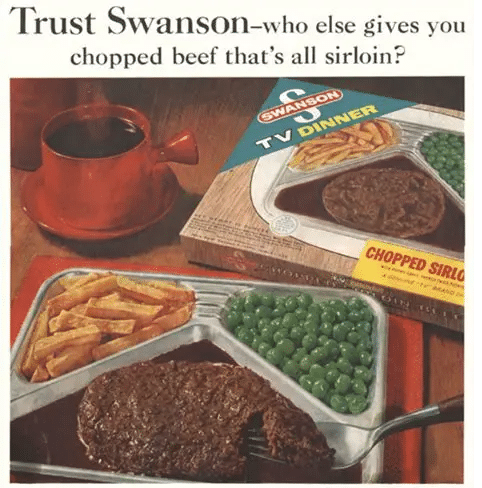
Pete said that after work the day before, he stopped by his dad’s house on his way home. Pete’s mom was away.
Pete’s dad was having dinner, and he was pairing wine with his food.
He was having a TV dinner with a bottle of ’44 Zinfandel.
Ranndy Piña
[email protected]
Sponsored
Author