Butterfly season brings hope to Napa Valley gardens
Every morning when I venture into my garden for my daily walk-through, I hope I will see the golden wings of a monarch butterfly. Occasionally I am lucky, but at this time of year, they are not laying eggs on my milkweed. They are just passing through on their journey to their summer breeding grounds. When they return to the coast in September, I am more likely to find eggs and babies.
I did recently see a pair of breeding gulf fritillary butterflies. They are also golden but only about half the size of the monarchs. Plantings of passionflower (Passiflora incarnata) have lured gulf fritillaries from the southern U.S. to California.
This morning, I finally saw a monarch visiting my butterfly garden. I could not get close enough to see if it was male or female. I also heard that a fellow master gardener has 100 monarch caterpillars in her garden. She lives in Carneros, so it sounds like the monarchs are working their way up the Napa Valley.
Each and every monarch sighting is important. We need hopeful signs that this valuable creature is making a comeback.
Female monarchs lay their eggs only on milkweed. Fortunately, some milkweed species are native to Northern California. Narrow-leaf milkweed (Asclepias fascicularis) and Asclepias speciosa are the two main types. For egg laying, monarchs prefer the narrow leaf plant. The larvae are willing to eat any milkweed.
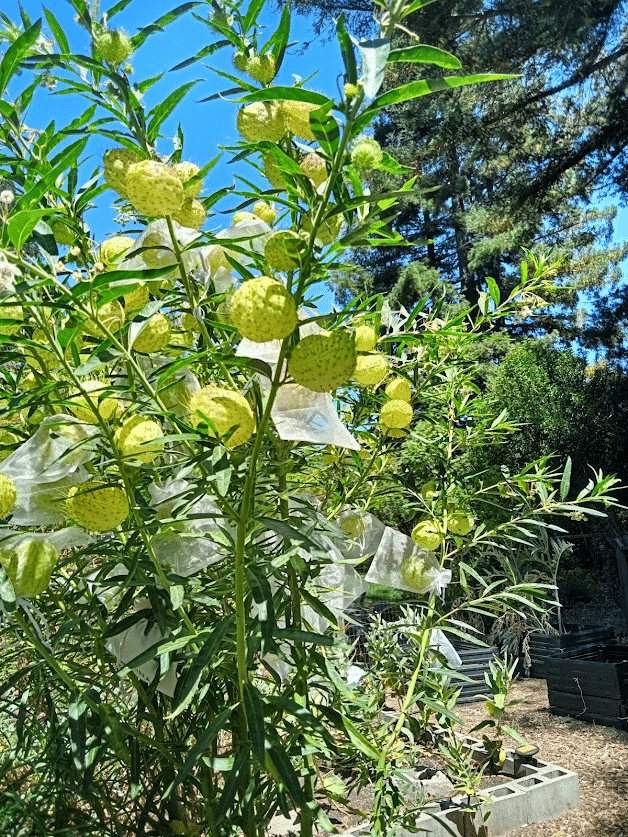
If you want to lure monarchs to your garden, avoid planting Asclepias curassavica. It is a tropical plant with orange and yellow flowers, and it does not die down in the winter. If you have
Ophryocystis elektroscirrha (OE), which is a parasite, in your garden and your milkweed does not die down over winter, the parasite can survive to infect the next generation. OE deforms and kills monarchs. Cutting the milkweed back to the ground in the winter somewhat controls the parasite.
I have read that a female monarch lays about 500 eggs during her six to seven weeks of life. Only about five of those eggs successfully make the transformation from egg to larva to pupa to butterfly. So, we need to help them on the journey.
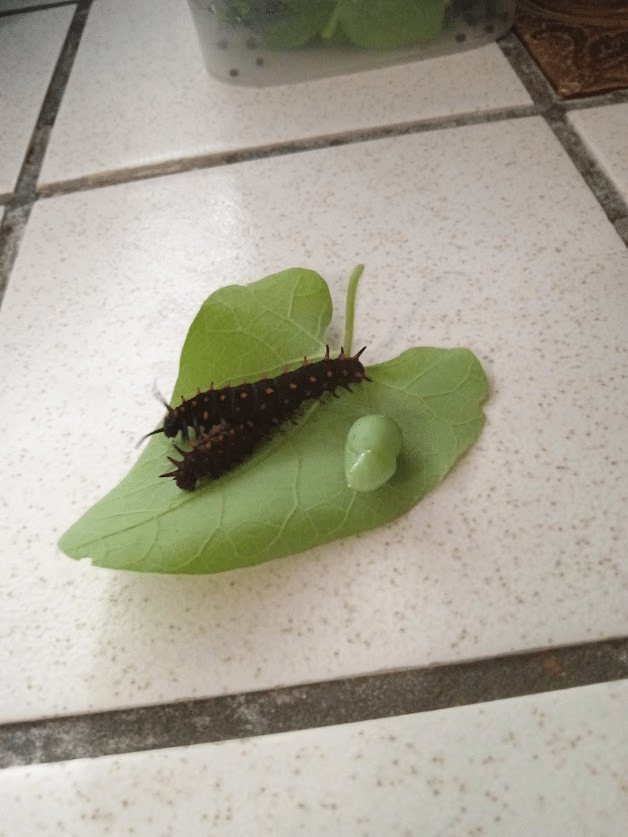
This brings me to California state law. It is illegal to hand-raise monarch butterflies in our state. To do so, you need to apply for a permit with the state Department of Fish and Game. The reason for the law is that it apparently confuses the butterfly to hand-raise them. Some people put large nets over their milkweed when the larvae are feeding to protect them from birds and insects. At the end of the larva stage, the larvae go in search of the perfect spot to make their pupae.
Sometimes you find pupae in the oddest places. I found two this year on pipevine leaves near my milkweed. I never saw these two in the larval stage.
Growing butterfly-friendly plants like milkweed will ensure you have plenty of butterfly visitors over the spring and summer. My butterfly garden is busy all day long with anise swallowtails, pipevine swallowtails, honeybees, carpenter bees, wild bees and hummingbirds. You can find a lot of information about gardening for butterflies online.
To learn more about butterfly gardens and attracting monarchs to your garden, register for “Be a Butterfly Angel,” a free Library Talk given by UC Master Gardeners of Napa County, on Thursday, Aug. 6, via Zoom. Details are below. Watch and learn from the comfort of your home.
Library talk: Join UC Master Gardeners of Napa County and Napa County Library for a free talk on “Be a Butterfly Angel” on Thursday, Aug. 6, from 7 to 8 p.m. via Zoom. Learn how to help support our declining population of Western monarch butterflies. Register to receive the Zoom link.
Tree walk: Join UC Master Gardeners of Napa County for a docent-led tree walk through historic Fuller Park in Napa on Friday, Aug. 7, from 10 to 11:30 a.m. Discover some of the many exotic and native trees in this 120-year-old arboretum. Meet at the corner of Oak and Jefferson Streets. Space is limited and registration is required for each participant.
Help Desk: The Master Gardener Help Desk is available to answer your garden questions. Use our online Plant Problem Help Form or email us at [email protected]. Include your name, address, phone number and a brief description of the problem. You can also visit us in person on Mondays and Fridays from 10 a.m. until 1 p.m. at the UC Cooperative Extension Office, 1710 Soscol Ave., Suite 4, Napa.