Calls for civility, transparency dominate Yountville Town Council meeting
While the topics of kindness and civility opened the Aug. 4 Yountville Town Council meeting, public calls for respectful disagreement, transparency and accountability set the tone as residents urged elected officials to improve meeting decorum, questioned a six-figure severance payment to the former town manager, asked for senior housing protection and sought greater oversight of town contracting practices.
Mayor Margie Mohler, Vice Mayor Pam Reeves and Councilmembers Eric Knight, Robin McKee and Hillery Trippe were in attendance, along with some 30 residents and guests.
Calls for Civility, Acceptance of Disagreement
Calls for more respectful public discourse began with comments from members of the Town Council. McKee, who publicly apologized in May for her inappropriate behavior from the dais in a town council meeting, called for kindness. “We have to be neighbors first. We have to be community first” she said, before Knight encouraged residents to “take the opportunity to share and connect with others in Yountville.”
Trippe, who was criticized at the last town council meeting by Vice Mayor Reeves, pointed to the Yountville Town Council Handbook, saying councilmembers have an obligation not to question one another’s motives. “We need to walk the talk,” she said.
Yountville resident Ashley Tenscher asked the council to return to consistent and orderly meeting behavior. She urged the council to reinforce rules of decorum for both councilmembers and members of the public when necessary.
“Chamber decorum creates a welcoming atmosphere,” Tenscher said. “The way we behave beyond this room reflects our culture. Our next town manager is watching, and we should present our best selves.”
While several speakers called for civility, another argued that respectful disagreement should not be mistaken for division.
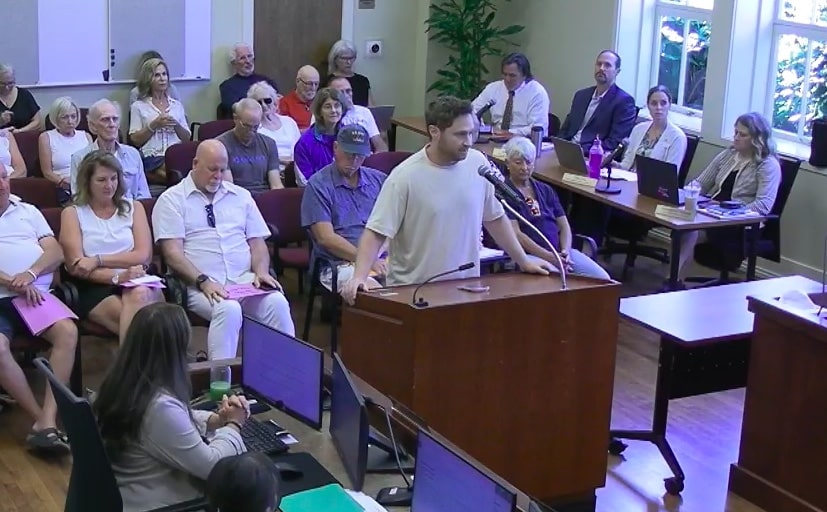
Yountville resident Eric Appel addressed the issue, challenging comments made by Vice Mayor Reeves during the May 21 Town Council meeting, which, he said, did not reflect what he has seen and heard around town.
“Residents of this town deserve representatives who treat dissenting opinions, elected or otherwise, with basic respect, and a council that cannot absorb criticism without lashing out does not exhibit a fundamental quality that public service demands,” he said.
Appel, who led the successful referendum campaign earlier this year that overturned the Commons zoning ordinance, also objected to Reeves’ characterization of the referendum.
“The absurdity of the comments made at the last meeting, calling the referendum effort an anti-democratic process completely inverts reality. That was democracy in its most direct form,” Appel said. “The right to petition for a referendum is constitutionally protected in California. It’s vehemently defended by the state Supreme Court. It exists precisely as a check on the elected officials when constituents feel unheard.”
He continued, “The fact that over 10% of this town’s population signed a petition within just a few days is not representative of a fringe protest on the edges of our community. It is a powerful signal of widespread public concern that deserved a serious response, and characterizing voters exercising their constitutional rights as anti-democratic is flat-out hypocrisy.”
“Disagreeing with someone and speaking in a public forum is not decisive and it’s not demonizing behavior. It is the bedrock of our democracy. It is the First Amendment in the Constitution for a reason, and it should be encouraged rather than decried. So, rather than demonizing fellow councilmembers and residents, the council should be asking itself why so many residents mobilized so quickly in the first place. You had a perfect opportunity to realign, reengage the community, maybe revive some of the good aspects of the project, and all it would have cost would have been the slightest amount of humility to admit that you made a mistake.”
Raulston’s Six-Figure Severance
Yountville resident Jill Turner read from a public comment letter she had submitted questioning the six-figure severance package awarded to former Town Manager Brad Raulston.
Turner referenced Raulston’s employment agreement, a public document, which states that if he voluntarily resigned, the town had no obligation to provide severance. She noted that Raulston received four months of pay plus an additional six months of severance which is estimated to total $250,000 or more.
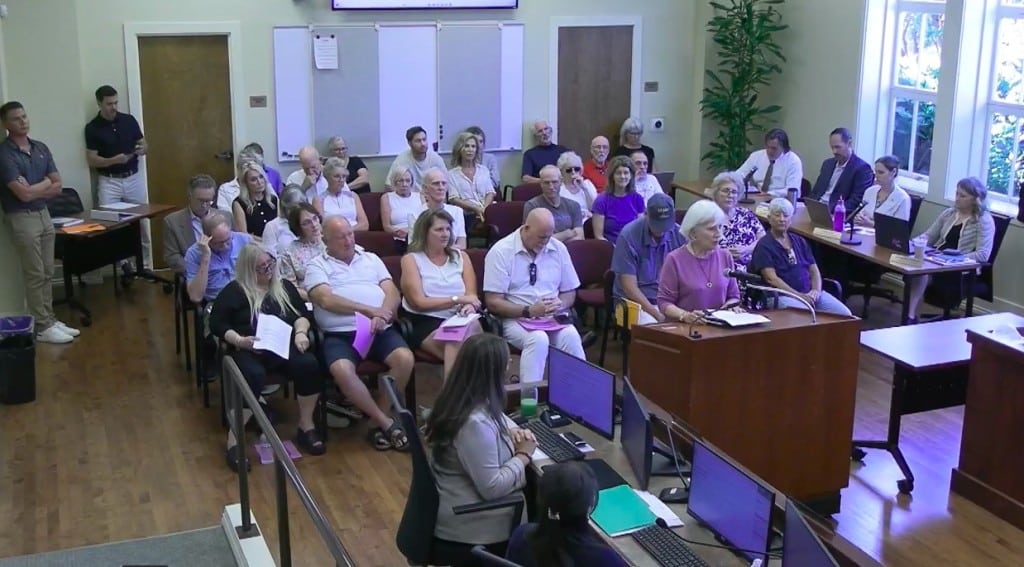
“Why was he paid severance that he was not entitled to receive?” Turner asked. “We deserve to hear the reason. It was our money as taxpayers. Please respond.”
Mayor Margie Mohler, who signed the severance agreement along with Raulston, asked Yountville Town Attorney Gary Bell to respond.
Bell said every town manager’s employment agreement contains severance provisions and that severance may be paid under certain circumstances. He also stated that Raulston, as a former employee, has privacy rights and referred residents to the town’s press release regarding his resignation in April, saying that was all the town intended to disclose.
As reported in the Sun on July 30, the April 29 press release stated that Raulston resigned “to care for his wife and make way for a leadership transition,” while in his actual resignation letter he wrote that the reasons included health concerns for his wife and “recent political and process challenges related to the Yountville Commons.”
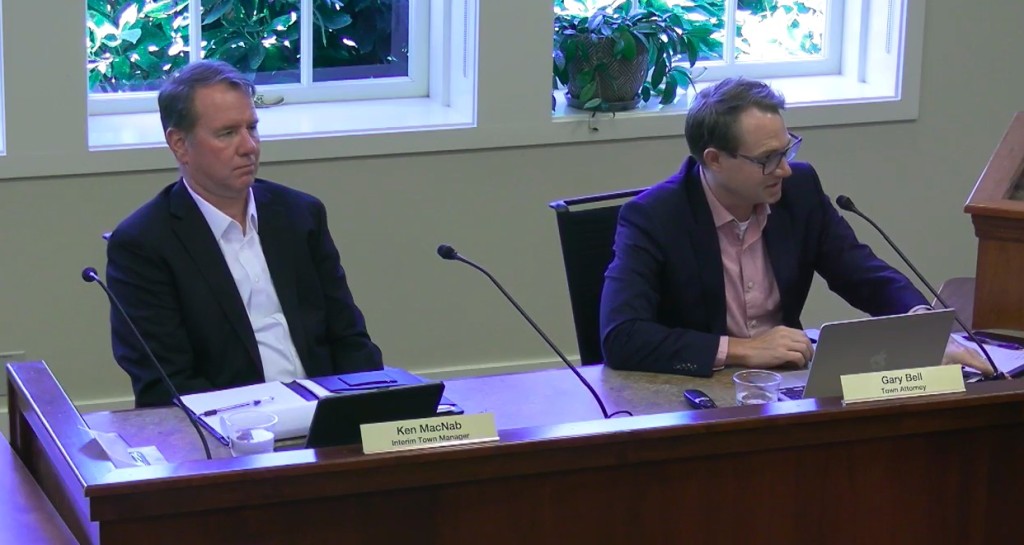
Trippe raised the same question. She noted that Raulston’s contract listed three possible separation scenarios, including voluntary resignation, which specifically stated no severance was required. Trippe asked whether the council had chosen to approve the severance package despite the contract language.
Bell again declined to provide additional information, instead reiterating that the town’s official press release represented the extent of its public response.
Joe Tagliaboschi also made a public comment in support of Turner and thanking Trippe for furthering the conversation about Raulston’s departure. “You all said he left of his own volition… He would be entitled to only what he accrued. It certainly doesn’t account for the four months that was given in addition to the six months of severance,” he said, adding a request for the council to pause the selection of a new town manager.
Rent Stabilization Ordinance
For several months, residents of Yountville’s two mobile home parks have urged the Town Council to consider adopting a Rent Stabilization Ordinance (RSO).
Town Attorney Gary Bell presented an overview of rent stabilization laws, outlined possible approaches available to the town and requested council direction.
Bell explained that California’s Tenant Protection Act of 2019 does not apply to mobile homes located on leased land, which is the arrangement at both Bella Vista and Rancho de Napa. He said, however, that local governments may adopt ordinances providing greater protections than state law.
He noted that approximately 104 California communities have adopted rent stabilization ordinances, often because mobile home parks represent one of the few remaining sources of affordable housing.
Policy considerations were outlined for the council. Establishing a local ordinance would require town staff to administer the program, respond to questions and oversee petitions. Bell said developing such an ordinance would involve a complex legal process and create additional administrative responsibilities and costs.
Several residents and representatives of both Yountville parks spoke during public comment. Councilmembers requested additional information on possible approaches before deciding, including the possibility of creating a stakeholder group so that residents, park owners and other interested parties could provide input.
Public Records Requests
Yountville Town Clerk Hilary Gaede presented a report on the town’s administration of the California Public Records Act, citing a significant increase in requests received by the town. Through the first seven months of 2026, the town has received 76 requests, nearly as many as it received during all of 2024 and 2025 combined.
Despite the increase, the town has maintained an average response time of eight days. Gaede noted that some requests are straightforward while others require considerably more staff time because of their scope and complexity.
Gaede point to the “Town Clerk” section of the Town of Yountville website, where users can submit or view a public records request, as well as many items such as agreements, invoices, and other frequently requested items filed in the town’s document center.
“We generally publish public most of the public records act requests that we receive, but sometimes we keep them private if there [were] no responsive records,” or something similar “where it wasn’t helpful because no information was shared,” Gaede said.
“But if there were public records used, then they would be on that portal?” Trippe asked.
“Yes, they would,” Gaede confirmed.
The records currently published online are available here: www.townofyountville.com/DocumentCenter.
Public Contracting Process Reviewed
Responding to questions raised during previous meetings, Town Attorney Gary Bell presented an overview of the town’s contracting procedures for professional services, goods and construction projects.
Bell explained how contracts are awarded under the Town Code and discussed the design-build process that was used for portions of the Commons project.
Councilmember Trippe revisited concerns about a previous $2 million Commons contract that combined several professional service providers into a single agreement. She said the contract lacked detailed rates and supporting information and asked whether the town could adopt a policy requiring competitive review for professional services contracts above a certain dollar amount.
Bell said the council could establish such a policy but would need to amend the Town Code.
Agreeing that greater transparency would be beneficial, Trippe requested that the issue be brought back to the council as a future policy discussion.
Other Items
The council approved a proposal from the Yountville Arts Commission, allowing the town manager to accept a gift from artist Richard Starks of Gilroy, who has displayed sculptures on the Yountville Art Walk since 2010. Starks offered to donate his sculpture Love Wine Too to the Town of Yountville in appreciation of the long-standing relationship. The Arts Commission plans to leave the sculpture in its current location near The Estate Yountville vineyard.
Ralph Andersen & Associates, the executive recruitment firm assisting the town with its search for a new town manager, reported that it has completed its community engagement process and presented a summary of its findings. The document can be viewed here: Town Manager Recruitment Community Engagement Summary.
Mark van Gorder, a PG&E local government affairs representative, addressed the recent series of power outages in Yountville, explaining that the most recent outage earlier this week occurred after a fallen tree on Yountville Cross Road brought down a utility pole.
Asked why the estimated restoration time was approximately five hours when power was restored in about one hour, van Gorder said replied that repair estimates are often conservative because crews cannot always determine how quickly repairs can be completed.
He also explained that the larger outage on July 5 was caused when a semi-truck took a corner too tightly and struck a power pole.
“If we have power outages, at times we have to patrol the lines and make sure that there isn’t something that’s fallen that we don’t see out there. If we restore the power in the summertime, if there is a branch or something on it catches fire and drops on a windy day, then we have catastrophic wildfires,” he said.
The next Yountville Town Council regular meeting is set for Tuesday, Sept. 15, at 3 p.m. This was the final public meeting scheduled prior to the Yountville legislative break from Aug. 15 through Sept. 1 during which meetings will not be held.