Napa County Master Gardeners: Invasive spotted lanternfly threatens grapes and other crops
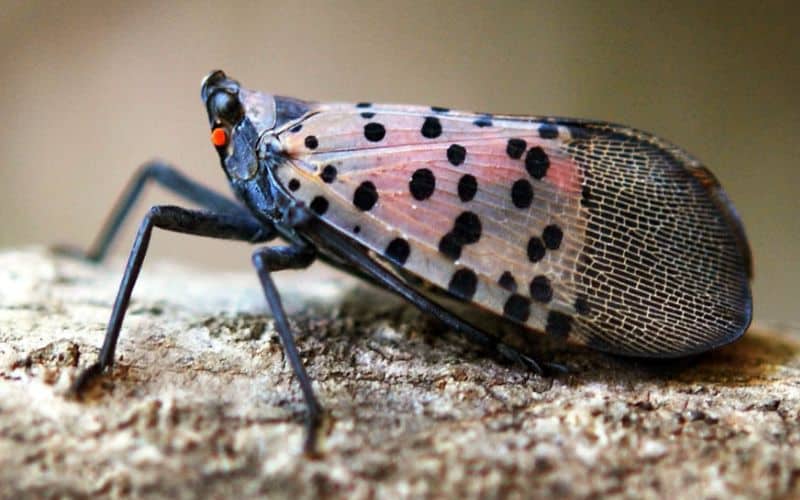
The spotted lanternfly (Lycorma delicatula) is an invasive agricultural pest from Asia. It was first detected in Berks County, Pennsylvania, in 2014 but may have been stateside a few years prior. It is native to China, India and Vietnam.
While the spotted lanternfly has turned up on the West Coast (California), it is more prevalent on the East Coast. It has been found in Illinois and Ohio and as far south as North Carolina. It can cause severe damage, especially to grapes and other fruit crops. It has already taken a toll on fruit production in the Eastern U.S.
It apparently hitchhiked into the country on a shipment of stones. The population has grown because the pest has no natural predators here to keep it in check.
The spotted lanternfly’s life cycle is the same as that of any other true bug in the order Hemiptera. True bugs are insects with piercing/sucking mouthparts, wings that are half leathery and a triangle on their back called a scutellum. They produce one generation a year. The eggs overwinter and hatch when temperatures are favorable.
Each lanternfly begins life as one egg among a mass of approximately 35 individual eggs, then goes through a gradual metamorphosis with four instars before becoming an adult. Gradual metamorphosis is the transformation of an insect from immaturity to adult. Unlike complete metamorphosis, where the insect changes in size and shape, a gradual metamorphosis is mostly about size, not shape. When an insect undergoes complete metamorphosis, the adult does not resemble the juvenile.
Lanternflies damage plants by feeding on the sap. They feed in groups, so are known as swarm feeders. Because of their feeding habits they could be vectors of plant pathogens, spreading bacteria and viruses to other plants, but this supposition has yet to be proven.
The spotted lanternfly’s piercing mouthpart taps into the plant’s phloem to extract the sap. While it feeds, it excretes a sugary waste known as honeydew. This sticky substance covers the leaves and encourages the development of a black fungus called sooty mold. The sooty mold inhibits photosynthesis, so the plant slowly declines.
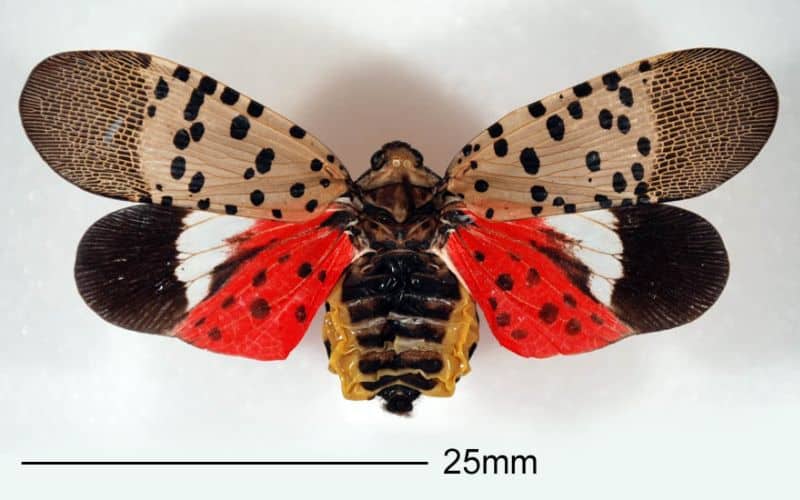
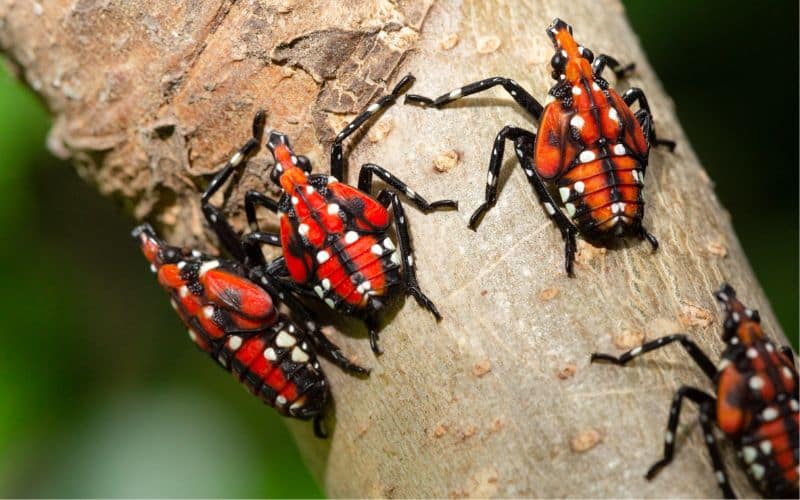
The spotted lanternfly’s preferred host plant is tree of heaven (Ailanthus altissima), considered an invasive weed.
For the time being, chemical insecticides are the most effective disruptor, followed by biological agents and cultural controls. Use chemical insecticides responsibly, following label instructions, and only when an infestation is otherwise uncontrollable. Some of the insecticides approved for vineyard use are Thiamethoxam, Malathion, Carbaryl, Bifenthrin and Phosmet.
Biological controls include entomopathogenic fungi and parasitoids. Entomopathogenic fungi are parasitic fungi that target and kill insects. Beauveria, Metarhizium and Hirsutella are all examples of parasitic fungi.
Removing egg masses by scraping them off and damaging them can be somewhat effective, along with simply squishing any spotted lanternflies you find. Using circle traps or sticky bands and vacuuming can reduce populations but won’t eliminate the problem. Sticky bands trap insects with a glue substance; circle traps encircle the trunk of a tree, capturing lanternflies and not allowing them a way out. Removing tree of heaven, if present, is also recommended.
If you see a spotted lanternfly, report it to your county agricultural department.
Become a Master Gardener: Join a group of enthusiastic local gardeners and become a UC Master Gardener of Napa County. Intimidated? No need! UC Master Gardeners do not know the answer to every gardening question, but they know how to find the answers. Register now to attend an information session about applying for the 2027 class. You must attend an information session to receive an application.
Library Talk: Join UC Master Gardeners of Napa County for a free talk on “Introduction to Bonsai, a Living Art Form” on Fall & Winter Vegetables” on Thursday, Sept. 3, from 7 to 8 p.m. via Zoom. Explore the history and practice of the ancient art of cultivating miniature trees to simulate full-grown trees in nature. Learn how to get started with bonsai and how to care for your living creations. Register to receive the Zoom link.
Help Desk: The Master Gardener Help Desk is available to answer your garden questions. Use our online Plant Problem Help Form or email us at [email protected]. Include your name, address, phone number and a brief description of the problem. You can also visit us in person on Mondays and Fridays from 10 a.m. until 1 p.m. at the UC Cooperative Extension Office, 1710 Soscol Ave., Suite 4, Napa.
All images courtesy of Commonwealth Agricultural Bureaux International (CABI).